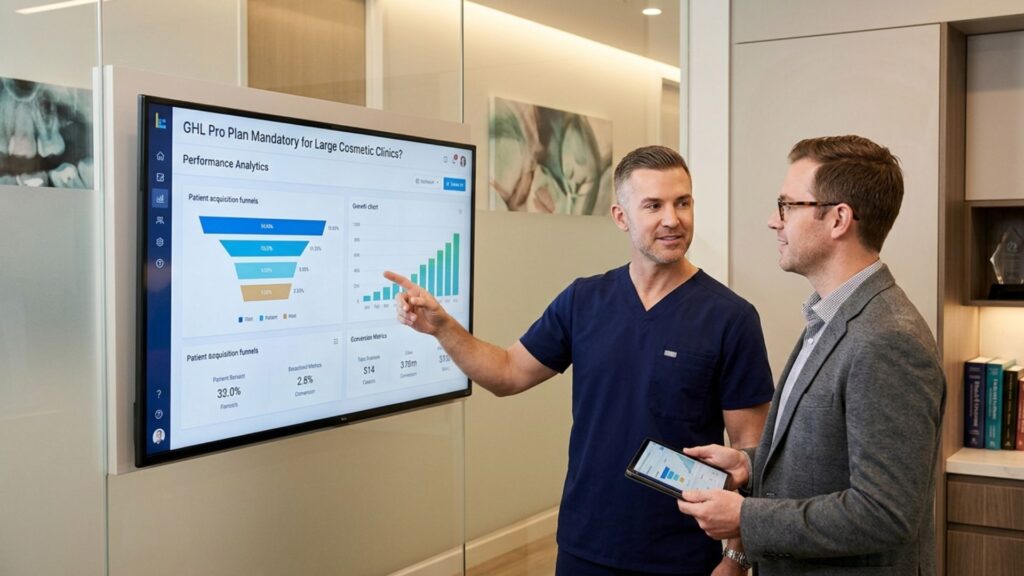
For the modern dental practice owner, the definition of success is shifting. Years of clinical mastery ensure high-quality patient outcomes, but clinical excellence alone no longer guarantees a thriving business. In an era of rising overheads, staffing shortages, and increasing patient expectations, the bottleneck is rarely the quality of the dentistry—it is the fragility of the operational systems.GHL Pro Plan Mandatory for Large Cosmetic Clinics
Most dental clinics operate in a state of “organized chaos.” The front desk is overwhelmed, patient follow-ups are inconsistent, and missed calls represent a silent but significant leak in the practice’s P&L. True growth does not come from working more hours; it comes from intelligent systems.
This article explores how structured systems and automation transform a high-stress practice into a predictable, revenue-stabilizing business.
1. The Operational Pain Points of the Modern Clinic
A dental clinic is a complex ecosystem. On any given day, your front desk staff is juggling check-ins, insurance verifications, phone inquiries, and emergency scheduling. In this environment, human error is not an “if,” but a “when.”
Common leakages include:
- The “One-and-Done” Inquiry: A potential patient calls about dental implants, doesn’t book immediately, and is never called back.
- The Empty Chair: A last-minute cancellation occurs, and the front desk is too busy to work the “short call” list, resulting in $500–$2,000 of lost hourly revenue.
- Post-Op Neglect: Patients leave without a follow-up, reducing the likelihood of long-term retention and referrals.
When these gaps exist, the owner-dentist often feels they must “drill more” to compensate for the financial loss, leading to burnout.
2. Defining “Intelligence” in a Dental Context
Intelligence in a clinic is often misunderstood. It is not just about the IQ of your staff or the advanced technology of your 3D imaging. It is the combination of Human Intelligence and System Intelligence.
Human Intelligence
This is your team’s ability to empathize with a nervous patient, explain a complex treatment plan, and build trust. This is irreplaceable. However, asking high-level staff to perform low-level repetitive tasks (like sending appointment reminders or chasing unconfirmed leads) is a poor use of human intelligence.GHL Pro Plan Mandatory for Large Cosmetic Clinics
System Intelligence
This is the “digital infrastructure” that works while your team sleeps. It is the logic that says: “If a patient doesn’t show up for their 2:00 PM appointment, wait 15 minutes, then send a polite automated text with a rebooking link.” System intelligence doesn’t get tired, doesn’t forget, and doesn’t have “bad days.”GHL Pro Plan Mandatory for Large Cosmetic Clinics
3. Is the GHL Pro Plan Mandatory for Large Cosmetic Clinics?
As clinics scale, especially high-ticket cosmetic practices, the volume of data becomes unmanageable for basic tools. This brings up a common technical question: Is GHL Pro Plan mandatory for large cosmetic clinics?
The short answer is: it depends on your growth model. While the basic GoHighLevel (GHL) plans offer excellent CRM and automation features, the Pro Plan is specifically designed for organizations that need advanced SaaS (Software as a Service) capabilities, multi-location management, and automated re-billing for communication credits.
For a large cosmetic clinic with multiple chairs or locations, the Pro Plan becomes “mandatory” not because of the name, but because of the scalability and control it offers. It allows the clinic to centralize its marketing, patient acquisition, and communication workflows into a single, white-labeled powerhouse that can be replicated across branches.GHL Pro Plan Mandatory for Large Cosmetic Clinics
4. AI & Automation: The New Front Desk Assistant
Automation is no longer a luxury; it is the “air traffic control” of your clinic. By implementing a system like GoHighLevel, you centralize every interaction into one dashboard.GHL Pro Plan Mandatory for Large Cosmetic Clinics
- Missed-Call Text Back: When a patient calls and the line is busy, the system immediately sends a text: “Sorry we missed you! How can we help?” This stops the patient from calling the dentist down the street.GHL Pro Plan Mandatory for Large Cosmetic Clinics
- Automated Lead Nurturing: If someone downloads a guide on “Invisalign vs. Braces” from your site, the system follows up over 7 days with educational content, eventually offering a consultation.
- No-Show Recovery: Automation can trigger a specific “re-engagement” sequence for patients who haven’t been seen in 6+ months.
Implementing these systems moves the clinic from a reactive posture to a proactive one.
Note: The link below is an affiliate link. I only recommend systems that align with structured clinic growth.
If you are looking to move away from manual tracking and toward a centralized infrastructure that captures every patient opportunity, a structured CRM is the first step.
5. Real-World Scenario: The $15,000 Leak
Consider a mid-sized clinic that receives 200 inquiries a month. Due to a busy front desk, 15% of those calls go to voicemail. Of those voicemails, only 50% are returned within two hours. By the time the staff calls back, the patient has often booked elsewhere.
By implementing a Missed Call Recovery system, that clinic captures an additional 15–20 leads per month. If only 3 of those leads convert to a $5,000 treatment plan, the system has generated $15,000 in “found” revenue without increasing the marketing budget by a single dollar.
This is why, for many, the question of whether a GHL Pro Plan is mandatory for large cosmetic clinics is answered by the ROI of recovered leads alone.
6. Common Mistakes in Clinic Automation
Despite the benefits, many clinic owners fail because they treat software as a “magic pill.”
- Over-Automation: Sending too many texts can feel cold and robotic. The goal is to facilitate human connection, not replace it.
- Fragmented Tools: Using one tool for email, another for SMS, and a third for the website leads to “Data Silos.” Centralization is key.
- Ignoring the Data: If your system shows you that 40% of leads drop off after the first consultation, that is a training issue, not a marketing issue.
According to the American Dental Association (ADA), practice management efficiency is one of the top predictors of long-term financial health. Relying on manual entries in the year 2026 is a risk most clinics cannot afford.
7. The Future of Structured Clinics
The future of dentistry belongs to the “Smarter Clinic.” These are practices where the dentist focuses on the operatory, while the digital system handles the “heavy lifting” of the patient lifecycle.
As you look at your 12-month goals, ask yourself: Are we growing because we are working harder, or because our systems are getting smarter? If the answer is the former, you are hitting a ceiling. To break through, you need infrastructure that scales.
Think of it this way—if your clinic loses even 5 missed calls per week, that’s silent revenue walking away. A structured automation system prevents that leak and ensures no patient falls through the cracks.
[Start Building a Smarter Dental System](INSERT YOUR AFFILIATE LINK HERE)
For free Trial
Conclusion
In summary, while the clinical side of your practice requires your hands, the business side requires a system. Whether you are a solo practitioner or a multi-location enterprise, the logic remains: capture the lead, nurture the relationship, and automate the mundane. For those managing high-volume operations, investigating whether a GHL Pro Plan is mandatory for large cosmetic clinics in your specific context is a vital step toward operational maturity.
Transitioning to an automated CRM like GoHighLevel is not about replacing your staff; it’s about giving them the freedom to focus on the patients in front of them, while the system takes care of the patients of tomorrow.
[Start Building a Smarter Dental System](INSERT YOUR AFFILIATE LINK HERE)
Part 2: The Dental Automation Blueprint—Moving from Chaos to Clinical Control
In the previous section, we established why systems are the engine of growth. But for the busy practitioner, a critical question remains: When does a dentist have the time to become a software engineer? True success isn’t found in merely purchasing tools; it is found in integrating them into the clinical workflow. When we ask, “Is GHL Pro Plan mandatory for large cosmetic clinics?” we are actually discussing scalability. Large-scale practices do not just need a tool—they need an ecosystem that acts as a safety net for human error.
8. The “Leaky Bucket” Audit: Where is Your Revenue Going?
Most dental practice owners believe they have a “new patient” problem. In reality, they usually have a “leaky bucket” problem. Without a structured system, revenue escapes through two primary gaps:
A. The 5-Minute Response Window
Research indicates that if you do not respond to an inquiry within five minutes, the odds of conversion drop by 80%. Platforms like GoHighLevel utilize “Speed to Lead” automation. While your front desk is occupied verifying insurance or greeting a patient, the system instantly engages the new lead via SMS, preventing them from calling the competitor down the street.
B. The Reactivation Goldmine
Your existing database contains hundreds of patients who haven’t visited in over six months. Manually calling them is an impossible task for a busy team. Automation allows you to launch a “Hygiene Recall” campaign, sending personalized SMS sequences to those due for a check-up, filling your calendar without a single outbound phone call.
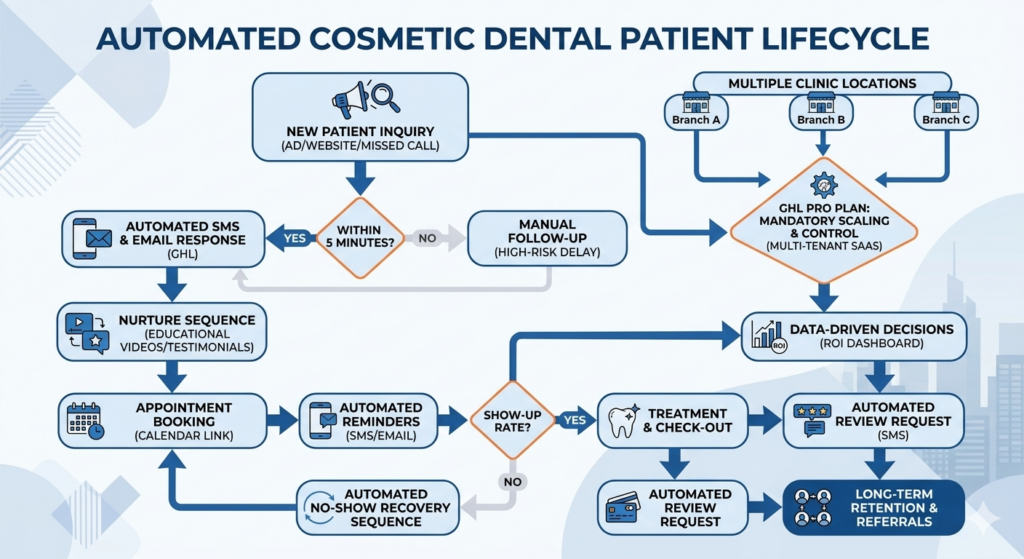
9. Advanced Workflow: The Patient Journey Map
In a high-end cosmetic practice, the patient journey is a multi-step process that requires constant touchpoints:
- Awareness: The patient engages with a social media or search engine advertisement.
- Capture: They submit a form. At this stage, the CRM securely logs their data.
- Nurture: If they don’t book immediately, the system sends educational content—such as “The Benefits of Porcelain Veneers”—keeping your clinic top-of-mind.
- Conversion: The patient books via an automated calendar link or a direct call-back triggered by the system.
For multi-location practices, managing this journey at scale is complex. This is why the GHL Pro Plan is mandatory for large cosmetic clinics looking to maintain separate sub-accounts and customized reporting for each branch without operational cross-contamination.
10. Breaking the “Front-Desk Overload” Cycle
Your front-desk team is the face of your practice; they should not be buried in data entry. Intelligent automation removes approximately 70% of repetitive administrative tasks:
- Automated appointment confirmations and reminders.
- Digital Intake Forms (completed by the patient before they arrive).
- Automatic Google Review requests sent immediately after treatment.
When the staff is freed from the “phone tag” cycle, they can provide a higher level of hospitality to the patients currently in the building, directly increasing retention.
Note: The link below is an affiliate link. I only recommend systems that align with structured clinic growth.
Consider the impact: if your staff saves just two hours a day and reinvests that time into following up on high-value treatment plans, the shift in monthly revenue is transformative. A structured system makes this possible.
[Start Building a Smarter Dental System](INSERT YOUR AFFILIATE LINK HERE)
11. Data-Driven Decisions vs. Guesswork
Without a centralized system, you are managing in the dark. You need to know:
- Which marketing channel is producing your highest-ticket cosmetic cases?
- What is your team’s “Lead-to-Appointment” conversion ratio?
- Exactly how much revenue is sitting in your “Unsold Treatment” pipeline?
A high-level dashboard provides these statistics in real-time. For large cosmetic clinics spending significant budgets on advertising, the GHL Pro Plan is mandatory for large cosmetic clinics to ensure that every marketing dollar is tracked and every lead is accounted for.
12. Implementation Strategy: Start Small, Scale Fast
You do not need to overhaul your entire operation overnight. A structured implementation follows these phases:GHL Pro Plan Mandatory for Large Cosmetic Clinics
| Phase | Focus Area | Objective |
| Phase 1 | Missed Call Text-Back | Ensure zero wasted patient inquiries. |
| Phase 2 | Appointment Reminders | Drive the no-show rate below 5%. |
| Phase 3 | Review Automation | Build online authority and trust automatically. |
| Phase 4 | Full Lead Nurturing | Convert long-term inquiries into active patients. |
Implementing these systems is not a “technical burden”—it is the process of putting your clinic on auto-pilot.GHL Pro Plan Mandatory for Large Cosmetic Clinics
To transform your practice from a standard dental office into a professional, scalable healthcare business, you must utilize the infrastructure that defines the modern industry standard.
[Start Building a Smarter Dental System](INSERT YOUR AFFILIATE LINK HERE)
13. Conclusion of Part 2
The landscape of dentistry is evolving. Competition is no longer just about clinical skill; it is about the patient experience and operational efficiency. Clinics that ignore the role of technology often find themselves spending more on marketing while their internal growth remains stagnant.
Systems (specifically GoHighLevel) provide the control that an owner-dentist requires: the financial freedom to grow and the peace of mind to step away from the office.
[Start Building a Smarter Dental System](INSERT YOUR AFFILIATE LINK HERE)