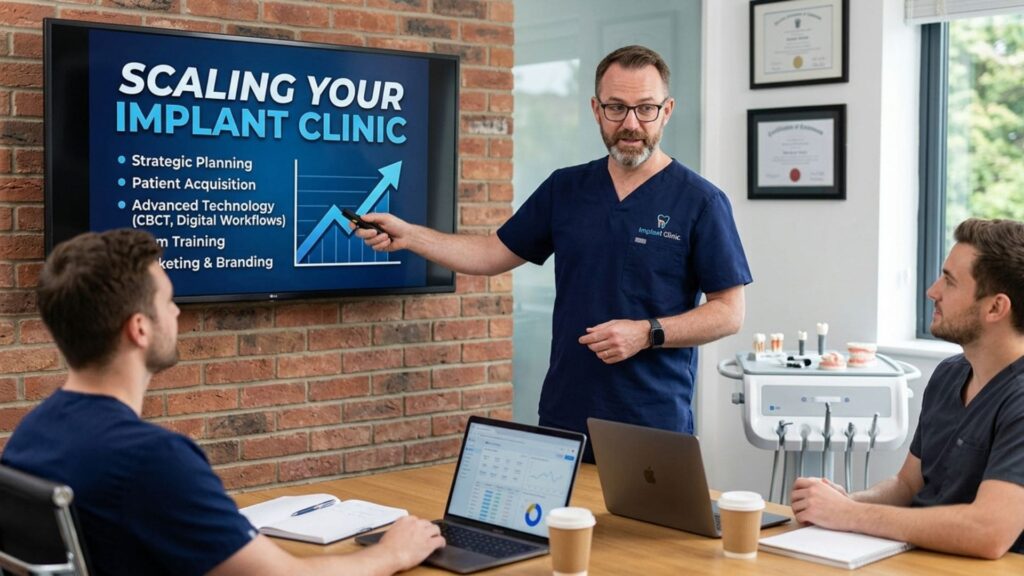
Scaling Your Implant ClinicIn the world of restorative dentistry, there is a common misconception that clinical mastery is the sole engine of growth. We are taught that if the implants are placed perfectly and the aesthetics are world-class, the business will naturally expand.
However, as many practice owners discover, clinical skill only gets you to a certain plateau. Beyond that point, you encounter the “Production Trap”: the more successful you are, the more overwhelmed your front desk becomes, the more leads fall through the cracks, and the more your personal time disappears.
Scaling your implant clinic is not about working more hours or even hiring more associates—at least not initially. It is about shifting your perspective from being a solo provider to being a systems architect. True growth comes from building a machine that educates patients, captures leads, and manages the lifecycle of a high-value case without requiring your constant manual intervention.
What Intelligence Means in a Dental Clinic
When we talk about “intelligence” in a clinic setting, we aren’t just talking about IQ. We are talking about the ability of the practice to process information efficiently. A clinic functions on two types of intelligence: Human and Systemic.
1. Human Intelligence
This is the specialized skill of your team. It’s your lead assistant knowing exactly which kit you need for a complex sinus lift, or your treatment coordinator sensing a patient’s hesitation and addressing their fear of the procedure. Human intelligence is irreplaceable for empathy and high-level clinical execution.
2. System Intelligence
This is the “infrastructure” of your business. It is the silent framework that ensures a patient who downloads a guide on “Dental Implants vs. Dentures” at 11:00 PM on a Sunday receives a follow-up email at 9:00 AM on Monday. System intelligence handles the repetitive, the mundane, and the data-driven tasks that humans often forget.
For most owners, the bottleneck in scaling your implant clinic is a lack of system intelligence. When you rely solely on human memory to follow up with a $20,000 full-arch lead, you are gambling with your revenue.
The Operational Pain Points of the Modern Implant Practice
Before we can scale, we must identify where the “leakage” occurs. In a high-ticket environment like implant dentistry, even small leaks are expensive.
- Missed-Call Leakage: Data suggests that up to 30% of calls to dental practices go unanswered or are placed on hold indefinitely. For a general cleaning, this is a minor loss. For a potential All-on-4 patient, this is a multi-thousand-dollar mistake.
- Front-Desk Overload: Your administrative team is often tasked with insurance verification, check-ins, answering phones, and social media. When they are overwhelmed, they stop “selling” and start “processing.”
- The Follow-up Gap: Research shows it takes between 5 to 12 touchpoints to convert a high-ticket lead. Most clinics stop after one or two phone calls.
- No-Show Economics: A canceled implant consultation isn’t just a gap in the schedule; it’s a waste of the marketing dollars spent to acquire that lead and the opportunity cost of the chair time.
AI & Automation: The Infrastructure of Growth
To solve these bottlenecks, we must look toward automation. Modern dental practices are increasingly adopting CRM (Customer Relationship Management) tools to act as the “brain” of their operations. Platforms like GoHighLevel have become the industry standard for clinics looking to centralize their communications.
Automation isn’t about replacing the human touch; it’s about protecting it. By automating the “educational” phase of the patient journey, you ensure that when a patient finally sits in your chair for a consultation, they are already 80% convinced of the value of the treatment.
For More Information
Strategic Note: Scaling your implant clinic requires a repository for every lead. Whether they come from Facebook, Google, or a referral, they must enter a single system where their journey is tracked and nurtured.
Think of it this way—if your clinic loses even five missed calls per week, that’s silent revenue walking away. A structured automation system prevents that by instantly texting back the caller and initiating a conversation.
[Start Building a Smarter Dental System](INSERT YOUR AFFILIATE LINK HERE)
Note: The link above is an affiliate link. I only recommend systems that align with structured clinic growth.
Real Clinic Scenarios: Automation in Action
Let’s look at how scaling your implant clinic looks in practice versus the traditional manual method.
Scenario A: The Manual Follow-Up
A patient calls on Tuesday afternoon asking about implants. The receptionist is checking out another patient and misses the call. She tries to call back an hour later, but the patient is now at work and doesn’t answer. The sticky note with the patient’s number gets buried under a stack of charts. Three days later, the receptionist remembers to call again, but the patient has already booked a consultation with a competitor who answered their message instantly.
Scenario B: The Automated Workflow
The same patient calls. The call is missed, but within 60 seconds, the patient receives a text: “Sorry we missed you! We’re currently helping another patient, but we’d love to help. Were you looking to book an implant consultation?”
The patient replies “Yes.” The system automatically sends a link to an educational video about the clinic’s implant technology and a calendar link to book a discovery call. The lead is captured, nurtured, and scheduled without the front desk lifting a finger.
This is the difference between a clinic that is “busy” and a clinic that is “scaling.”
Common Mistakes When Scaling
In my experience as a strategist, I see three recurring errors when doctors try to grow their implant production:
- Throwing More Money at Leads: Most doctors think they need more leads. In reality, they need a better “net” to catch the leads they already have. Doubling your ad spend while having a 40% missed-call rate is simply burning money.
- Over-complicating the Tech: You don’t need 10 different apps. You need one central hub (a CRM) that handles your SMS, Email, and Calendar.
- Ignoring Education: Implant dentistry is a “considered purchase.” Patients are scared of the pain, the cost, and the process. If you don’t provide automated education before the consult, you will spend your entire day repeating the same basic information.
The Power of Automated Education
If you want to focus on high-value surgery, you must stop being the primary educator for basic questions. By using automated email or SMS sequences, you can send “The Patient’s Guide to Dental Implants” to every lead automatically.
By the time they arrive, they understand:
- Why implants are better than bridges.
- The technology you use (e.g., CBCT scans, 3D printing).
- Your financing options.
This shifts the consultation from “Should I do this?” to “How do we get started?” This is a fundamental pillar of scaling your implant clinic.
Implementing a system that handles these touchpoints allows your team to focus on the patients currently in the office, providing a premium experience that leads to referrals.
[Start Building a Smarter Dental System](INSERT YOUR AFFILIATE LINK HERE)
The Future of Structured Clinics
As we move further into 2026, the gap between “traditional” clinics and “structured” clinics will widen. Patients now expect the same level of digital convenience from their dentist as they do from Amazon or Uber. They want to book online, receive text reminders, and get answers to their questions instantly.
Scaling is no longer just about buying the latest surgical robot. It is about the digital patient experience. For those looking for further insights into clinical trends and professional standards, resources like the American Academy of Implant Dentistry provide excellent guidance on maintaining clinical excellence while you grow your practice.
The “Future-Proof” clinic is one where the doctor is free to be a doctor, while the system handles the business of being a business.
Conclusion: Taking the First Step
Scaling your implant clinic is a marathon, not a sprint. It begins with the realization that your time is your most valuable asset. Every minute you spend chasing a lead or explaining the basics of a bone graft is a minute you aren’t in the operatory or leading your team.
Start by auditing your current “leaks.” Look at your missed call rate. Look at your no-show rate. If those numbers aren’t where they should be, it’s time to move away from manual checklists and toward automated infrastructure.
Transitioning to a smarter system doesn’t just increase your revenue—it stabilizes it. It gives you the visibility to see exactly where every dollar of your marketing budget is going and the peace of mind to know that no patient is being forgotten.
If you are ready to stop the chaos and start building a predictable, scalable implant practice, the tools are already available to make it happen.
[Start Building a Smarter Dental System](INSERT YOUR AFFILIATE LINK HER
Here is the English version of Part 2, specifically crafted with a senior strategist’s tone, focusing on operational depth and the “Scaling Your Implant Clinic” framework.
Part 2: Advanced Systems for Scaling Your Implant Clinic — Beyond the First Consultation
In the previous section, we discussed the fundamentals of automated lead capture and initial education. However, the true test of scaling your implant clinic begins the moment a prospective patient walks out of your front door. In high-ticket restorative dentistry, the conversion cycle is rarely a straight line; it is a marathon of trust-building.
If your system is designed only to “get them in” but fails to “bring them back,” you are capping your growth at the knees.
Database Reactivation: The Hidden Goldmine
Many clinic owners spend thousands of dollars chasing “cold” new leads while sitting on a goldmine of existing patient data. These are individuals who expressed interest months ago but, for whatever reason, didn’t start treatment.
Scaling your implant clinic becomes significantly more cost-effective when you implement “Database Reactivation.” An automated SMS or email campaign targeting patients from six months ago can fill your surgical calendar without spending an extra cent on new advertising. By reaching out with a value-driven educational update, you move the “undecided” into the “booked” column.
Structured Patient Lifecycle Management
A high-growth clinic views the patient journey through four distinct, automated phases:
- Awareness: The moment they realize they need a solution for missing teeth.
- Education: When they understand your specific expertise and technology (like CBCT or Guided Surgery).
- Conversion: The moment the treatment plan is signed and the deposit is paid.
- Advocacy: When a satisfied patient becomes a referral source.
Automation bridges these phases. When your system automatically triggers the next step in the journey, you eliminate the “human friction” that leads to lost opportunities.
The Economics of No-Show Prevention
In implant dentistry, a “no-show” isn’t just a missed cleaning; it’s a massive operational loss. Surgical time is expensive, and sterilized kits represent sunk costs.
Traditional confirmation calls often fail because patients simply don’t answer unknown numbers. An intelligent system utilizes 2-way SMS, allowing patients to confirm or reschedule with a single tap. If a patient fails to confirm within a set window, the system alerts your staff instantly to fill that gap.
Think of it this way — if you prevent just two high-value “no-shows” per month, the automation system has paid for itself ten times over. Scaling your implant clinic is built on these small, systemic efficiencies that compound into massive annual revenue.
[Start Building a Smarter Dental System](INSERT YOUR AFFILIATE LINK HERE)
Note: The link above is an affiliate link. I only recommend systems that align with structured clinic growth.
Managing the “Post-Consultation” Gap
The most common point of failure for large implant cases is the “Post-Consult” silence. A patient leaves, discusses the $25,000 quote with their spouse, gets nervous about the surgery, and goes quiet.
This is where System Intelligence saves the deal. Twenty-four hours after the consult, your system can automatically trigger a video message of you (the doctor) explaining the long-term benefits of the procedure or a link to your financing partner. This maintains a “personal touch” and builds authority without requiring you to pick up the phone.
Leveraging Reviews for Authority
Scalability is fueled by reputation. Does your staff consistently ask for a review after every successful surgery? Automation makes this a non-negotiable part of the workflow. As the patient is checked out, a review link is sent to their phone. A high volume of positive Google reviews directly correlates to higher organic rankings and a lower cost-per-lead for those looking for implants in your area.
Common Mistakes: The “Complexity” Trap
When doctors attempt scaling your implant clinic, they often fall into the trap of “app-fatigue”—buying one software for reviews, another for SMS, and a third for lead tracking.
True growth lies in simplicity. You need a centralized hub (a CRM) where your front desk can see exactly where every patient stands on one screen. When your data is fragmented, your team becomes confused, and efficiency drops. A single, unified platform provides the clarity needed to lead.
[Start Building a Smarter Dental System](INSERT YOUR AFFILIATE LINK HERE)
The Future: Predictive Clinic Operations
As we move forward, the most successful clinics will be those that understand their data. Scaling your implant clinic requires you to know your “Cost Per Acquisition” (CPA).
When you know that spending $500 in marketing consistently yields a $5,000 case, you can scale with total confidence. Automation tools like GoHighLevel provide the dashboards necessary to turn “guessing” into “knowing.” Every dollar spent is tracked, and every lead is accounted for.
Conclusion: Strategic Scaling vs. Hard Work
Clinical excellence is your foundation, but strategic systems are your accelerator. You can be the best implant surgeon in the country, but if your business infrastructure is outdated, you will always be trading time for money.
Transform your clinic into an automated machine that operates even when you are in surgery or on vacation. This is the only path to true operational freedom.
[Start Building a Smarter Dental System](INSERT YOUR AFFILIATE LINK HERE)
Frequently Asked Questions (FAQs)
1. Does scaling require hiring more staff immediately?
No. In fact, scaling should start by making your current staff 2–3x more productive through automation. Only hire once your systems are so efficient that you physically cannot handle the volume.
2. How many times should the system follow up with an implant lead?
Research suggests 5–12 touchpoints are needed for high-ticket sales. Automation allows you to hit these touchpoints in the background without annoying the patient or exhausting your staff.
3. Can I integrate this with my existing practice management software?
Yes. Most modern CRMs act as a communication and marketing layer that sits on top of your clinical software to handle the “front-end” patient experience.
4. Is patient data secure in these automation platforms?
When scaling your implant clinic, always choose HIPAA-compliant versions of platforms like GoHighLevel to ensure that all patient communications and records remain secure.
5. Why are reviews so important for scaling implants specifically?
Implants are a “trust-based” purchase. Patients are looking for social proof that you have successfully performed this surgery on people just like them.
6. When is the best time to start implementing these systems?
The best time is before you feel overwhelmed. If you wait until you are “too busy,” you won’t have the mental bandwidth to oversee the implementation.