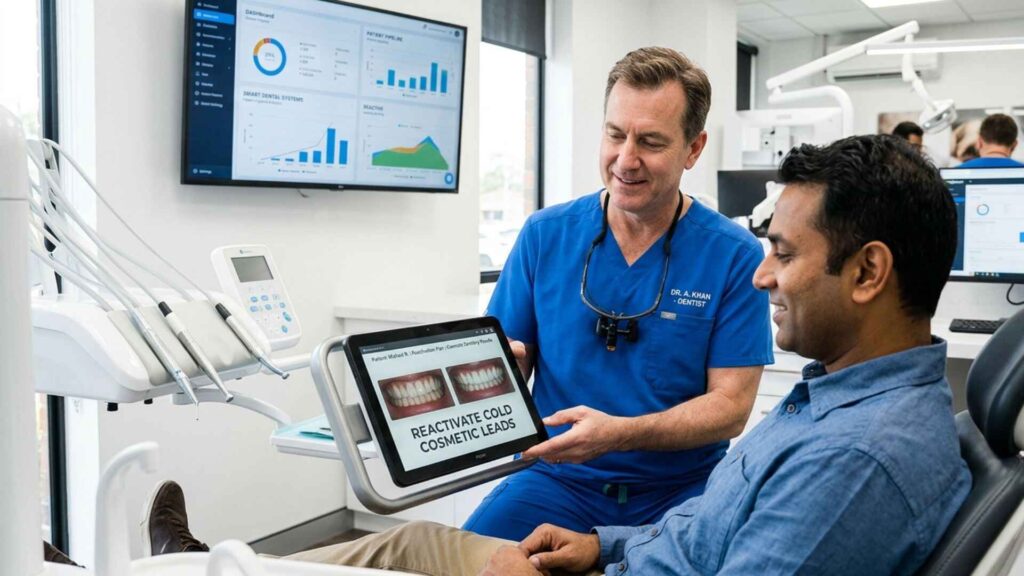
For the modern dental practice owner, the definition of “success” has shifted. A decade ago, being the best clinician in a five-mile radius was a sufficient moat. Today, clinical excellence is merely the baseline—the entry fee. The real differentiator between a practice that scales predictably and one that plateaus in a cycle of burnout is operational intelligence.Reactivate Cold Cosmetic Leads Without Manual Calling
Most dentists are trained to diagnose malocclusions and periodontal disease, not lead-leakage and “no-show economics.” Consequently, many clinics operate in a state of “leaky bucket” syndrome: spending heavily on marketing to attract new patients while the existing patient base evaporates through the holes of a manual, overwhelmed front-desk system.
Growth does not come from working more hours or mastering a new implant technique alone. It comes from building a structured infrastructure where no lead is forgotten, no call goes unreturned, and every dormant patient is systematically invited back.
What “Intelligence” Means in a Dental Clinic
In a high-functioning practice, intelligence is split into two categories: Human Intelligence and System Intelligence.
1. Human Intelligence
This is the intuitive, empathetic work your team performs. It’s the front-desk coordinator recognizing a patient’s voice, the assistant easing a child’s anxiety, and the doctor explaining a complex treatment plan. This is high-value labor. However, when your human intelligence is bogged down by low-value tasks—like calling to confirm appointments three times or manually typing out “Where are you?” texts—your ROI on staff wages plummets.
2. System Intelligence
System intelligence is the digital “nervous system” of your clinic. It is the invisible architecture that tracks a lead from the moment they click an ad to the moment they sit in the chair. It ensures that if a patient cancels, a text is automatically sent to the next person on the waitlist.
When these two forms of intelligence work in harmony, the clinic stops feeling like a chaotic fire station and starts feeling like a precision-engineered business.
The Economics of the “Missed Opportunity”
To understand the need for systems, we must look at the math of failure. In an average mid-sized clinic, the “missed call” rate during lunch hours or busy morning rushes can hover around 20-30%. If each new patient acquisition is worth a lifetime value (LTV) of $1,000 to $5,000, missing just three calls a week represents a silent revenue loss of over $150,000 annually.
Furthermore, the “no-show” isn’t just a lost appointment; it’s a hole in your overhead. Your fixed costs—rent, staff salaries, utilities—remain the same whether the chair is full or empty. Systematizing your follow-up process isn’t just “nice to have”; it is the primary mechanism for revenue stabilization.
Leveraging AI & Automation: The Role of Infrastructure
This is where the transition from manual labor to automated systems becomes critical. Modern platforms, such as GoHighLevel, have moved beyond simple CRM (Customer Relationship Management) functionality. For a dental clinic, these tools serve as an automated “Front Desk 2.0.”
Instead of relying on a receptionist to remember to follow up with a lead who didn’t book, a system-driven clinic uses automated workflows. These workflows can:
- Trigger instant “Missed Call Text-Back”: If a call goes unanswered, the system immediately texts the patient: “Sorry we missed you! We’re with a patient—how can we help?”
- Centralize Multi-Channel Communication: Consolidate Instagram DMs, Google Business messages, and SMS into one dashboard so nothing slips through the cracks.
- Automate the Nurture Sequence: Send educational content about Invisalign or dental implants to patients who expressed interest but weren’t ready to commit on day one.
By centralizing these functions, the clinic owner gains visibility. You can finally see exactly where patients are dropping off in the funnel, allowing for data-driven decisions rather than “gut feeling” guesses.
Note: The link below is an affiliate link. I only recommend systems that align with structured clinic growth.
Transitioning from a manual “memory-based” front desk to an automated infrastructure is the only way to scale without adding more administrative headcount. A structured system ensures your clinic remains productive even when your team is busy with in-office patients.
[Start Building a Smarter Dental System](INSERT YOUR AFFILIATE LINK HERE)
Real Clinic Scenarios: The Power of the “Reactivation”
One of the most overlooked assets in any dental practice is the “Cold Lead.” These are individuals who once inquired about a high-ticket procedure—perhaps veneers or a full-mouth restoration—but went silent.
In a traditional clinic, these leads stay buried in a spreadsheet or a filing cabinet. In a system-driven clinic, you use specific triggers to Reactivate Cold Cosmetic Leads.
The Strategy: Reactivate Cold Cosmetic Leads
Instead of a generic “Checking in” phone call (which usually goes to voicemail), a system can send a personalized, value-driven SMS or email sequence. For example, sharing a “Before & After” gallery or a brief educational video on the latest minimally invasive cosmetic techniques.
According to healthcare industry benchmarks on patient engagement, re-engaging existing leads is 5x more cost-effective than acquiring new ones via paid ads. By focusing your automation on the goal to Reactivate Cold Cosmetic Leads, you tap into a “hidden” goldmine of revenue that has already been paid for in previous marketing spend.
The “No-Show” Recovery Loop
Consider another scenario: A patient cancels a $2,000 crown prep at the last minute.
- The Manual Way: The receptionist tries to call three people on a handwritten list. No one picks up. The chair stays empty for two hours.
- The Systematized Way: The cancellation triggers an automated blast to a “Priority Waitlist” via SMS. The first patient to reply “YES” is automatically booked, and the calendar is updated.
Think of it this way—if your clinic loses even 5 missed calls per week, that’s silent revenue walking away. A structured automation system prevents that leak while freeing your staff to focus on the patients physically in the building.For Free Trial
[Start Building a Smarter Dental System](INSERT YOUR AFFILIATE LINK HERE)
Common Mistakes in Dental Operations
Even with the best intentions, clinic owners often fall into “The Software Trap.” They buy five different tools—one for reminders, one for reviews, one for marketing—and none of them talk to each other.
- Fragmented Data: When your lead data is in one place and your patient records are in another, you lose the “single source of truth.” You end up marketing to people who are already patients or, worse, ignoring high-value leads.Reactivate Cold Cosmetic Leads
- Over-Automation: Automation should feel like a bridge to a human, not a wall. If a patient feels like they are talking to a rigid robot, the trust (which is the currency of dentistry) is broken.Reactivate Cold Cosmetic Leads
- Ignoring the “Middle of the Funnel”: Most clinics are good at the “Top” (getting a lead) and the “Bottom” (doing the dentistry). They fail in the middle—the follow-up, the education, and the long-term nurture.Reactivate Cold Cosmetic Leads
The Future of the Structured Clinic
As we move further into an era of AI-assisted healthcare, the clinics that thrive will be those that treat their operations as a product. Imagine a clinic where:
- New patient intake forms are completed and synced before the patient arrives.Reactivate Cold Cosmetic Leads
- Post-op instructions are sent via video text exactly 2 hours after a procedure.
- Automated “Happy Birthday” messages include a gentle reminder for a cleaning.
- The system identifies when a patient hasn’t been in for 12 months and automatically launches a sequence to Reactivate Cold Cosmetic Leads or general hygiene patients.
This isn’t science fiction; it is the current standard for high-growth practices using platforms like GoHighLevel. These systems don’t replace your staff; they give your staff the “superpowers” to handle twice the volume with half the stress.
Building a clinic that runs without your constant physical presence requires a shift in mindset. It requires moving from “Doctor-Centric” to “System-Centric.” When the system handles the follow-ups, the reminders, and the lead tracking, the doctor is finally free to do what they do best: provide exceptional care.
[Start Building a Smarter Dental System](INSERT YOUR AFFILIATE LINK HERE)
In Part 1, we established the core thesis: clinical skill is the baseline, but system intelligence is the growth engine. If Part 1 was about the “Why” and the basic infrastructure, Part 2 is about the “How”—the granular execution of systems that turn a stagnant patient database into a predictable revenue stream.
As a clinic owner, you are likely familiar with the “Plateau of 80%.” This is where your chairs are mostly full, your staff is constantly busy, yet your net profit doesn’t budge. This happens because “busy” does not always equate to “profitable.” Without a centralized CRM like GoHighLevel, your team is likely spending 80% of their energy on administrative friction rather than high-value patient interactions.
The Anatomy of the “Silent Loss”
In dental operations, revenue doesn’t just disappear; it leaks out through unmonitored gaps. Let’s look at the three primary “leaks” that a structured system plugs:
- The Unconverted Consultation: A patient comes in for a cosmetic consult, hears the price, and says, “I’ll think about it.” Without automation, that lead is effectively dead.
- The “Treatment Pending” Void: Thousands of dollars in diagnosed treatment sit in your Practice Management Software (PMS), gathering digital dust because no one has the time to call 200 people.
- The Marketing Black Hole: You spend $3,000 on Google Ads, but because the front desk was handling a patient check-out, four high-intent leads went to voicemail and never called back.
Operational Strategy: The “Double-Tap” Recovery
To fix these leaks, we move beyond simple reminders. We implement Behavioral Triggers.
Imagine a scenario where a prospective patient clicks an ad for dental implants but doesn’t book. A standard clinic does nothing. A “Smarter Dental System” executes a “Double-Tap”:
- Tap 1 (Instant): An automated SMS sent within 2 minutes: “Hi [Name], saw you were looking into our implant options. Do you have a specific question about the procedure or financing?”
- Tap 2 (Day 2): An automated email delivering a Case Study or a video of the Lead Clinician explaining the technology used at the practice.
This isn’t “selling”—it’s proactive patient advocacy. You are providing the information they need to make a decision before they drift away to a competitor.
Note: The link below is an affiliate link. I only recommend systems that align with structured clinic growth.
By automating the “Double-Tap” and other nurture sequences, you ensure that your marketing budget actually converts into chairs filled, rather than just “clicks” and “impressions.”
[Start Building a Smarter Dental System](INSERT YOUR AFFILIATE LINK HERE)
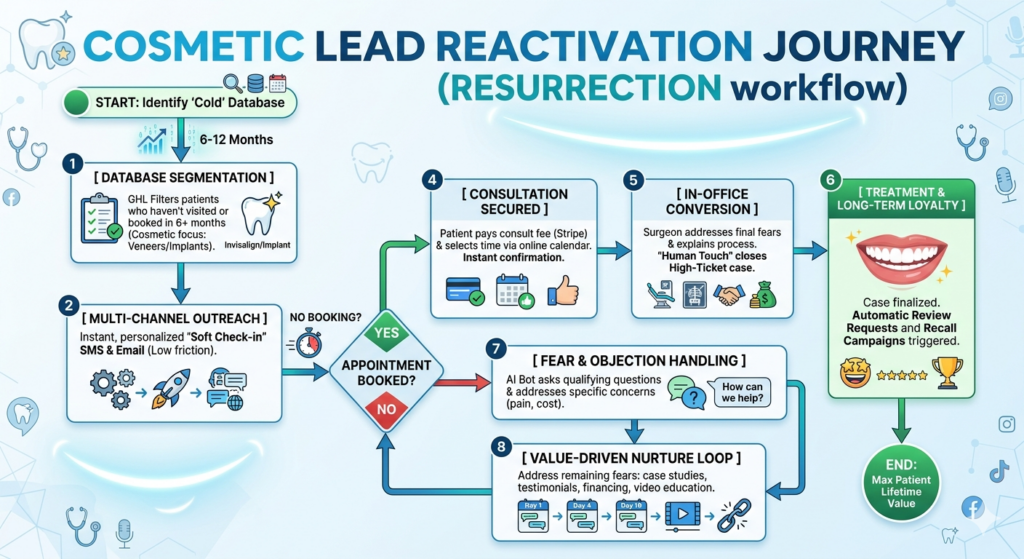
Deep Dive: How to Reactivate Cold Cosmetic Leads
Most clinic owners assume that if a cosmetic lead didn’t book six months ago, they aren’t interested. This is an expensive mistake. Often, the timing just wasn’t right—financially, emotionally, or logistically.
To Reactivate Cold Cosmetic Leads, you need a system that categorizes these prospects by their specific interests (e.g., Veneers vs. Clear Aligners) and re-engages them with a low-friction offer.
The “Progress Update” Workflow
Instead of asking, “Do you want to buy now?”, your automated system sends a message highlighting a new advancement or a limited-time financing window:
“Hi [Name], we’ve just updated our 3D imaging tech for our veneer smile designs. Since you expressed interest a few months ago, would you like to see a quick 2-minute video on how we can now show you your results before we even start?”
According to recent dental marketing data, targeted reactivation campaigns have a 4x higher conversion rate than “cold” social media ads. When you Reactivate Cold Cosmetic Leads through an automated pipeline, you are essentially harvesting “low-hanging fruit” that your competitors have forgotten.
The “Overhead vs. Efficiency” Equation
A common concern for clinic owners is the cost of adding new technology. However, we must look at the Opportunity Cost of Manual Labor.
| Task | Manual Cost (Staff Time) | Automated Cost (System) |
| Following up with 50 leads | 4-6 Hours | 0 Seconds |
| Appointment Confirmations | 2 Hours/Day | 0 Seconds |
| Google Review Requests | 1 Hour/Day | 0 Seconds |
| Total Waste | ~40 Hours/Month | N/A |
By shifting these 40 hours back to your front-desk coordinator, they can focus on In-Office Experience and Treatment Presentation. This is how you increase your case acceptance rate without hiring more people.
Think of it this way—if your clinic loses even 5 missed calls per week, that’s silent revenue walking away. A structured automation system prevents that.
[Start Building a Smarter Dental System](INSERT YOUR AFFILIATE LINK HERE)
The Future: Predictive Practice Management
The next evolution of dental systems involves Predictive Analytics. Platforms like GoHighLevel allow you to see your “Pipeline Value.” You can look at a dashboard and see that you have $85,000 worth of “pending” cosmetic dentistry in the follow-up stage.
When you have that level of visibility, the stress of “Where is next month’s revenue coming from?” disappears. You don’t guess; you look at the data. You see which campaigns are working and which ones are leaking money. You move from being a “worker in the business” to a “strategist over the business.”
Conclusion: Implementing the Infrastructure
The transition to a systemized clinic doesn’t happen overnight, but it does start with a single decision: to stop relying on human memory and start relying on digital logic. By centralizing your communications and automating your lead nurture, you create a practice that is resilient, scalable, and—most importantly—profitable.
Whether your goal is to eventually exit your practice or simply to regain your Friday afternoons, the path is the same: Systems over Effort.
[Start Building a Smarter Dental System](INSERT YOUR AFFILIATE LINK HERE)
FAQs (Part 2)
1. Can this system handle multi-doctor clinics?
Yes. Modern CRMs can route leads to specific “calendars” or coordinators based on the procedure type or the specific doctor the patient requested.
2. How does this help with Google Reviews?
You can set a trigger so that 1 hour after a patient’s appointment is marked “Complete” in your system, they receive a text thanking them for their visit and providing a direct link to your Google Business Profile.
3. What if I already have a marketing agency?
Most agencies focus on “Top of Funnel” (getting the lead). A CRM like GoHighLevel is “Middle and Bottom of Funnel.” It ensures the leads your agency sends you don’t go to waste. You can even give your agency access to the system so they can see exactly which leads turned into actual patients.
4. Is the data secure?
When choosing an automation platform, ensure it offers HIPAA-compliant features or secure messaging protocols to protect patient privacy and stay within dental regulatory guidelines.