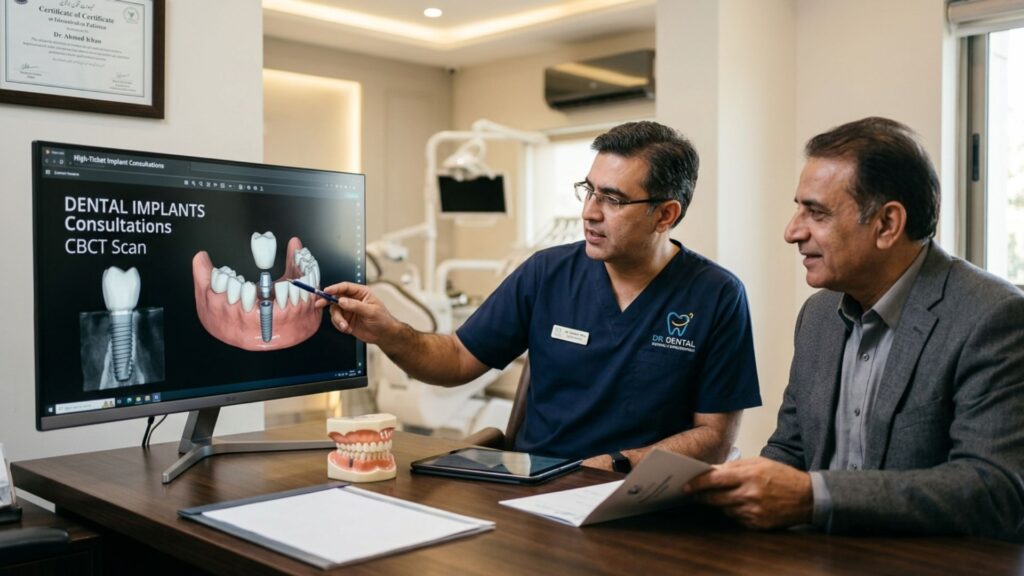
For the modern dental practice owner, the definition of “growth” has shifted. A decade ago, a thriving practice was defined by clinical excellence and a steady stream of word-of-mouth referrals. Today, clinical excellence is merely the baseline—the “ante” to get into the game.High-Ticket Implant Consultations
The true bottleneck in 2026 isn’t the quality of the titanium posts or the precision of the 3D surgical guides. It is the operational leakage occurring between the first click on an ad and the patient sitting in the chair. In the high-stakes world of High-Ticket Implant Consultations, where a single case can range from $20,000 to $50,000+, relying on a manual front-desk workflow is no longer a viable business strategy; it is a financial liability.
1. The Operational Pain Points: Why “Busy” Isn’t “Profitable”
Most practice owners I consult with are exhausted, yet their P&L statements don’t reflect that level of effort. They suffer from what I call “The High-Ticket Paradox”: they have the leads, they have the skill, but their calendar is a mess of no-shows and “let me think about it” follow-ups that never happen.
Consider these four silent killers of dental revenue:
- Missed-Call Leakage: A prospective All-on-4 patient calls at 5:15 PM. The front desk has just left. That patient doesn’t leave a voicemail; they call the next clinic on Google.
- The Follow-Up Black Hole: A lead expresses interest in High-Ticket Implant Consultations, but isn’t ready to book today. They are added to a “list” that no one ever calls back.
- No-Show Economics: An hour of a surgeon’s time is worth thousands. When a high-ticket consult no-shows because they forgot or got “cold feet,” the opportunity cost is devastating.High-Ticket Implant Consultations
- Front-Desk Overload: Your best receptionist is spent confirming cleanings and filing insurance claims instead of nurturing high-value implant candidates.
2. What “Intelligence” Means in a 2026 Dental Clinic
Growth does not come from working more hours; it comes from intelligent systems. Intelligence in a clinic setting is divided into two distinct categories: Human and Systemic.
Human Intelligence
This is your staff’s ability to empathize, handle complex clinical questions, and close the deal in the room. You cannot automate the “trust” factor required for someone to agree to major oral surgery. Human intelligence should be reserved for high-level tasks: treatment coordination and patient care.
| Lead Filtering Stage | Traditional Manual Lead | GHL Automated Lead |
| Initial Intent | “Just price shopping” | Pre-qualified for financing |
| Medical History | Staff asks during first call | Self-reported via GHL Smart Form |
| Trust Building | Relying on doctor’s bio | Automated 5-Day Video Series |
| Consultation Fee | Hard to collect over phone | Automated pre-payment (Stripe) |
System Intelligence
This is the “digital glue” that holds the practice together. System intelligence handles the repetitive, the mundane, and the time-sensitive. It ensures that no lead is ignored and no patient is forgotten.
3. System Intelligence: The Architecture of Automation
To stabilize revenue without burning out your staff, you must move toward a centralized infrastructure. Platforms like GoHighLevel have become the industry standard for this because they allow a clinic to centralize communication, reminders, and lead tracking inside one structured environment.
Instead of having your lead data scattered across Post-it notes, Gmail, and your Practice Management Software (PMS), a CRM-based automation system creates a “Single Source of Truth.”
AI & Automation in the Patient Journey
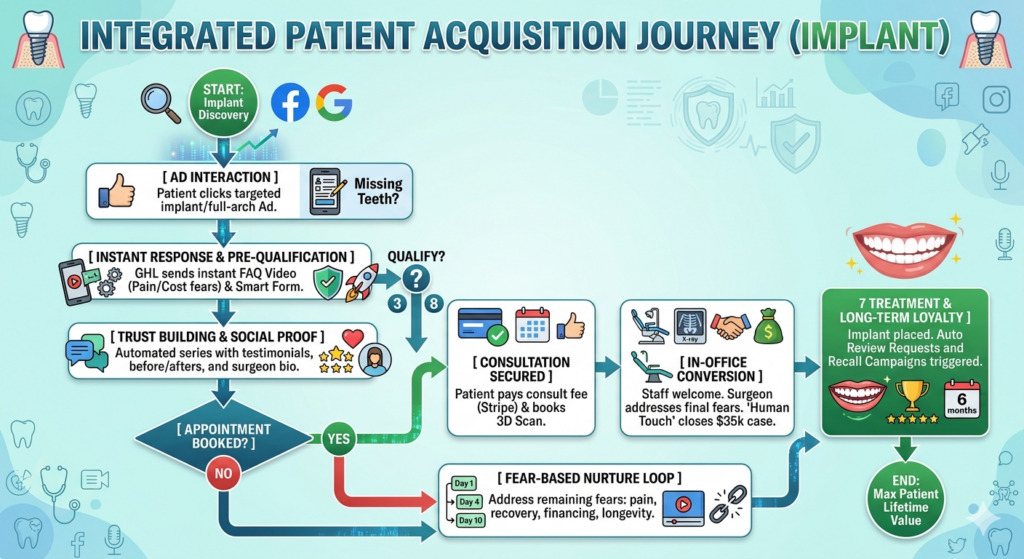
In 2026, AI is no longer a gimmick; it is a triage tool. When a lead enters your ecosystem for High-Ticket Implant Consultations, the system should immediately:For Free Trial
- Acknowledge: Send an instant SMS (under 2 minutes) to start the conversation.
- Qualify: Use automated branching logic to ask, “Do you currently wear dentures?” or “How many teeth are you missing?”
- Nurture: Send a series of educational videos via email that explain the benefits of implants over traditional bridges.
Think of it this way: if your clinic loses even five missed calls per week from high-intent patients, that is silent revenue walking away. A structured automation system prevents that by providing an immediate, automated safety net.
Note: The link below is an affiliate link. I only recommend systems that align with structured clinic growth.
[Start Building a Smarter Dental System](INSERT YOUR AFFILIATE LINK HERE)
4. Real Clinic Scenarios: From Chaos to Control
Let’s look at two common scenarios and how system intelligence changes the outcome.
Scenario A: The Manual Follow-Up (The Old Way)
A patient clicks an ad for dental implants on a Tuesday night. The lead sits in an email inbox until Wednesday morning. The receptionist calls twice; the patient is at work and doesn’t answer. The lead is forgotten.
- Result: $0 revenue. $150 ad spend wasted.
Scenario B: The Automated Pipeline (The 2026 Way)
The same patient clicks the ad on Tuesday night. Within 30 seconds, they receive an SMS: “Hi Sarah, thanks for inquiring about our dental implant options! Would you like to see a few transformations from our recent patients?” Sarah replies “Yes.” The system sends a link to a gallery and a booking calendar. She schedules her own consult for Thursday.
- Result: High-intent patient booked without a single staff member lifting a finger.
Building this kind of predictability into your practice isn’t about being “techy”—it’s about protecting your time and ensuring that your clinical skills are actually being utilized on paying patients.
[Start Building a Smarter Dental System](INSERT YOUR AFFILIATE LINK HERE)
5. Common Mistakes in Implementing Automation
Even with the best tools like GoHighLevel, many clinic owners fail because they treat automation like a “set and forget” toy.
- Over-Automating the Human Touch: Patients seeking High-Ticket Implant Consultations need to feel cared for. If your automated texts sound like a robot, they will disengage. The goal is to facilitate the connection, not replace it.
- Ignoring Data Integrity: If your staff doesn’t update the “Pipeline” (moving a lead from ‘New’ to ‘Consult Booked’), the automation can’t work. You must treat your CRM as the heartbeat of the business.
- Fragmented Tools: Using one tool for SMS, another for email, and a third for landing pages leads to “Data Silos.” Centralization is the key to visibility.
6. The Future of Structured Clinics
As we move further into 2026, the gap between “Systematized” clinics and “Manual” clinics will widen. Manual clinics will see their overhead rise as they hire more staff to handle the same volume of work. Systematized clinics will scale their revenue while keeping their headcount lean.
The objective is Revenue Stabilization. When you know that every lead is being nurtured and every missed call is being recovered, you stop worrying about “where the next big case is coming from.” You transition from being a reactive dentist to a proactive CEO.
Before you invest in another piece of clinical equipment, consider the infrastructure that brings patients to that equipment. A robust CRM and automation strategy is the highest-ROI investment a modern practice can make.
[Start Building a Smarter Dental System](INSERT YOUR AFFILIATE LINK HERE)
7. Conclusion
Dental growth does not come from better dentistry alone—it comes from intelligent systems. By automating the outreach and follow-up for High-Ticket Implant Consultations, you free your team to focus on what they do best: providing world-class patient care.
The technology exists to eliminate the “chaos” of the front desk. The question is whether you will continue to manage that chaos or build a system to replace it.
FAQs
Q: Will automation make my practice feel cold or impersonal? A: Actually, it’s the opposite. By automating the “logistics” (reminders, booking, initial intake), your staff has more time to have meaningful, unhurried conversations with patients when they arrive.
Q: Do I need to replace my existing Practice Management Software (PMS)? A: No. Tools like GoHighLevel sit “on top” of your PMS. They handle the marketing and lead-nurturing side, while your PMS handles the clinical records and billing. For more on how these systems integrate with broader healthcare standards, see the American Dental Association (ADA) guidelines on digital integration.
Q: How long does it take to see results? A: Most clinics see a reduction in missed-call leakage within the first 48 hours of implementing “Missed Call Text Back” features. Full pipeline optimization usually takes 30–60 days of data collection.
Q: Is this difficult for a non-tech-savvy staff to learn? A: The beauty of a structured system is that it simplifies the staff’s job. Instead of checking five different places for messages, they have one dashboard to manage. If they can use a smartphone, they can use a modern CRM.
If Part 1 was about understanding the “Why” behind systems, Part 2 focuses on the “How”—specifically, how to optimize these systems for High-Ticket Implant Consultations. In 2026, simply having automation isn’t enough; your automation must be hardwired to align with patient psychology.
When a patient searches for a $30,000 All-on-4 procedure, they aren’t just looking for a surgeon; they are looking for a seamless, high-trust experience. If your digital touchpoints feel scattered or delayed, the patient instinctively fears that your clinical work might be just as disorganized.
1. The “Speed to Lead” Rule in High-Ticket Cases
In dental surgery, timing is everything—and the same applies to sales. Data shows that if you don’t respond to a new lead within 5 minutes, their likelihood of converting drops by 80%.
In 2026, my advice as a Senior Strategist is this: Make Inbound Response Automation your top priority. When a prospect inquires about dental implants at 11:00 PM, your system should immediately trigger a “Pre-Qualification” sequence.
This achieves two critical goals:
- The patient feels heard and acknowledged instantly.
- Your staff arrives in the morning to a list of leads who are already vetted and ready for High-Ticket Implant Consultations.
2. Decision-Making Psychology: The “Nurture” Loop
High-ticket dental implants are rarely an impulsive purchase. On average, a patient takes 3 to 6 months to move from curiosity to the chair. If your clinic remains silent during this window, you lose the case to the competitor who stayed “top of mind.”
System Intelligence shines in long-term nurturing. Your CRM (like GoHighLevel) should handle this automatically:
- Day 1: Send a case study (Before/After transformations).
- Day 7: Deliver a video of the doctor addressing “Dental Anxiety” or “The Reality of Implant Pain.”
- Day 30: Provide information on third-party financing and flexible payment plans.
Think of it this way—if your system reactivates just 10% of your “old” leads every month, you could potentially double your bookings without increasing your ad spend by a single dollar.
3. Financial Visibility: Beyond the “EBITDA” Guesswork
Many clinic owners reach the end of the month without knowing exactly where their marketing budget went. The goal of automation isn’t just sending messages; it’s Attribution.
When you utilize a centralized infrastructure, you gain total clarity:
- You know exactly how many leads came from Google vs. Facebook.
- You see how many clicked specifically for High-Ticket Implant Consultations.
- You track how many reached the consultation room and what their total treatment plan value was.
This level of control prevents burnout because you aren’t guessing. You are making data-backed decisions.
A clinic without a tracking system is like a surgeon operating without a modern X-ray. You might be highly skilled, but you are working blindly. A structured CRM provides the diagnostic clarity your business office needs.
Note: The link below is an affiliate link. I only recommend systems that align with structured clinic growth.
[Start Building a Smarter Dental System](INSERT YOUR AFFILIATE LINK HERE)
4. The “No-Show” Shield: Multi-Channel Reminders
The primary reason high-ticket consultations no-show isn’t forgetfulness—it’s fear. Patients get “cold feet” regarding the cost or the surgery itself.
A 2026-ready system mitigates this anxiety through a structured touchpoint sequence:
- Instant SMS Confirmation: Immediate peace of mind once booked.
- Educational Email: Sent 2 days prior, explaining exactly what to expect during the consult to lower the “fear of the unknown.”
- Personalized Voice Drop: A pre-recorded greeting from the doctor welcoming them to the practice.
When a patient receives this level of personalized attention, their psychological commitment to the appointment skyrockets, often dropping no-show rates from 30% down to 5%.
5. Staff Empowerment, Not Replacement
A common misconception is that automation replaces the front desk. In reality, it transforms them from “Admin Clerks” into “Patient Advocates.”
When software handles the mundane logistics of reminders and lead tracking, your treatment coordinator is freed up to have deep, meaningful conversations with patients. This is the “Human Intelligence” that actually closes High-Ticket Implant Consultations.
[Start Building a Smarter Dental System](INSERT YOUR AFFILIATE LINK HERE)
6. Implementation Roadmap: The Path Forward
If you’re feeling overwhelmed, follow this three-step strategic approach:
- Centralize Communications: Connect all channels (GMB, Social Media, Website) into one unified dashboard.
- Activate Missed Call Text-Back: Ensure every missed call receives an immediate automated text response.
- Visual Pipeline Management: Create a clear digital “path” where every lead’s status (Cold, Warm, Consult Booked, Deposit Paid) is visible at a glance.
The future belongs to the practitioners who prioritize their operations as much as their clinical continuing education. By integrating a platform like GoHighLevel, you aren’t just buying software; you are building a scalable asset that works 24/7.
[Start Building a Smarter Dental System](INSERT YOUR AFFILIATE LINK HERE)