As a clinic owner, you’ve likely felt the “Clinical Ceiling.” You have mastered the technical nuances of restorative work, your chairside manner is impeccable, and your team is dedicated. Yet, the month-end numbers often feel like a treadmill—high effort, high overhead, but stagnant growth.
The reality of modern dental operations is that clinical excellence is merely the “ante” to get into the game. The actual profit margin of a dental practice is won or lost in the spaces between the appointments. It is lost in the unreturned missed call, the unconfirmed hygiene recall, and the lead that sat in an email inbox for three days while the front desk was busy handling an insurance dispute.
This is the Ultimate GHL Guide for Clinics, designed to move you away from the “heroic effort” model of management toward a systematic, automated infrastructure. Growth does not come from working more hours; it comes from intelligent systems that capture value while you are holding a handpiece.
What “Intelligence” Means in a Dental Clinic
In a clinical setting, we define intelligence by diagnostic accuracy and treatment success. In dental operations, intelligence is defined by predictability.
An “intelligent” clinic is one where the owner knows, with mathematical certainty, how many leads are in the pipeline, why patients are dropping off the schedule, and exactly how much revenue is recovered through automated follow-ups. Most clinics operate in a “reactive fog.” They wait for the phone to ring. If it doesn’t ring, they wonder why. If it rings and isn’t answered, the opportunity simply vanishes into the ether.
To build a sustainable practice, we must bifurcate our approach into two distinct categories: Human Intelligence and System Intelligence.
1. Human Intelligence: The High-Value Touch
Your team’s intelligence should be reserved for empathy, complex problem-solving, and closing high-ticket treatment plans (All-on-4s, Invisalign, full-mouth recons). When your front desk staff spends four hours a day playing “phone tag” for routine cleanings, you are mismanaging your most expensive resource: human talent.
2. System Intelligence: The Digital Infrastructure
System intelligence is the “always-on” layer of your business. This is where tools like GoHighLevel (GHL) enter the conversation. A CRM (Customer Relationship Management) system doesn’t replace your staff; it acts as a digital net that catches everything the humans miss. It handles the repetitive, the mundane, and the time-sensitive tasks that don’t require a degree or a high hourly wage.Ultimate GHL Guide for Clinics
AI & Automation: Plugging the Revenue Leaks
The most significant bottleneck in a dental clinic is communication latency. Research shows that if a prospective patient’s inquiry isn’t addressed within five minutes, the likelihood of conversion drops by over 80%. No front desk team, no matter how efficient, can maintain a five-minute response time 24/7.Ultimate GHL Guide for Clinics
This is where automation becomes a clinical necessity . By utilizing a centralized platform, you can implement:”Check out our previous guide on [Read the More Detail] to understand how AI is changing dental workflows.”
- Missed Call Text-Back: If the front desk is on the other line and misses a call, the system immediately sends a text: “Ultimate GHL Guide for ClinicsSorry we missed you! We’re helping another patient. How can we help you today?” This halts the patient’s search for another dentist.
- Unified Inbox: Consolidating Instagram DMs, Facebook messages, Google Business chats, and SMS into one dashboard.
- Automated Nurture Sequences: Moving a “maybe” on a $30,000 treatment plan to a “yes” through a series of educatioUltimate GHL Guide for Clinicsnal emails and texts sent over 90 days—without the treatment coordinator lifting a finger.
Think of it this way: if your clinic loses even five missed calls per week, that’s silent revenue walking away. A structured automation system prevents that leak and ensures every inquiry is acknowledged instantly.
Note: The link above is an affiliate link. I only recommend systems that align with structured clinic growth.
Real-World Scenarios: System Intelligence in Action
To understand the impact of a platform like GoHighLevel, let’s look at two common operational failures and how a systematic approach solves them.
Scenario A: The “Ghost” New Patient Lead
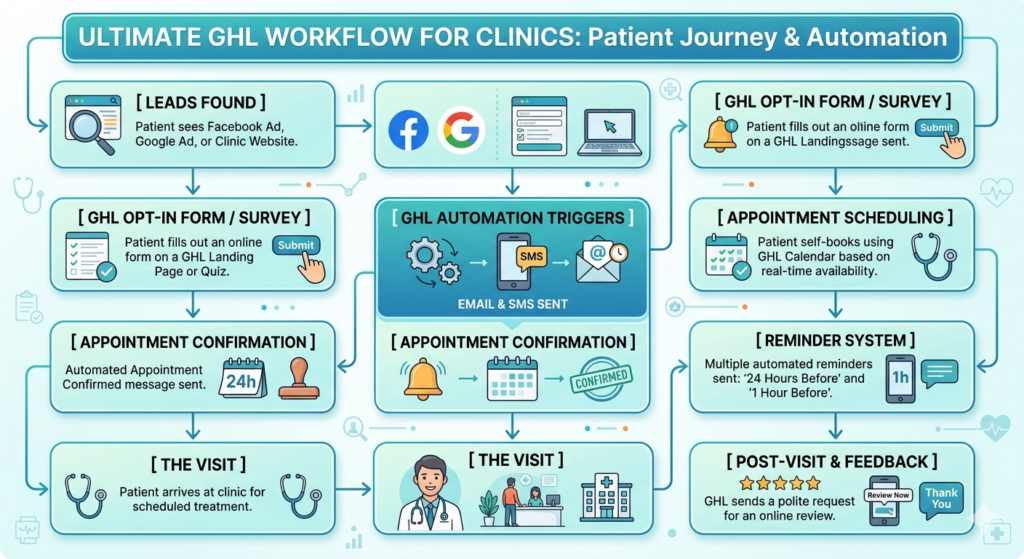
A patient finds your clinic via a Google Ad at 8:00 PM. They fill out a contact form.
- The Manual Way: The email sits in an inbox until 9:00 AM the next day. The front desk calls at 10:00 AM, but the patient is now at work and doesn’t answer. They play phone tag for three days. The patient eventually calls the dentist down the street who answered their phone.
- The Systematized Way: The moment the form is submitted, GHL sends an automated SMS with a booking link. The patient schedules themselves at 8:05 PM. The system sends a medical history form immediately. The patient arrives the next day, fully “prepped” by the system.
Scenario B: The Hygiene Black Hole
A patient cancels their cleaning and says, “I’ll call you back to reschedule.”
- The Manual Way: The front desk writes it on a sticky note or relies on a manual “callback list” that is rarely completed due to the chaos of the morning rush.
- The Systematized Way: The patient is moved to a “Reactivation Pipeline.” The system sends a friendly text in 48 hours, then another in 7 days, then a final “We miss you” offer in 14 days. This happens automatically until the patient rebooks.
Managing a clinic without a CRM is like trying to perform an extraction without a radiograph—you are working blind. Implementing a structured system gives you a dashboard for your entire business.
[Start Building a Smarter Dental System](INSERT YOUR AFFILIATE LINK HERE)
Common Mistakes: Why “Tech” Often Fails Clinics
Many clinic owners purchase software and find it doesn’t move the needle. This usually happens for three reasons:
- The “Set and Forget” Fallacy: Automation is not a replacement for management. You must still review your “Opportunity Pipeline” weekly to see where patients are getting stuck.
- Over-Automation: If your texts sound like robots, patients will disengage. The goal of this Ultimate GHL Guide for Clinics is to facilitate human connection, not replace it. Use automation to get them in the chair, then use your human intelligence to keep them there.
- Data Silos: When your booking software doesn’t talk to your marketing software, you have a fragmented view of the patient. Platforms like GoHighLevel act as a “Single Source of Truth.”
According to the American Dental Association (ADA), practice overhead continues to rise. The only way to combat rising costs without raising your prices to unsustainable levels is to increase operational efficiency.
The Future of the Structured Clinic
The dental industry is moving toward consolidation. Private equity firms are buying practices not because they are “better at dentistry,” but because they are better at systems. They use CRMs to track the “Cost Per Acquisition” (CPA) and “Lifetime Value” (LTV) of every patient.
For the independent clinic owner, adopting these same tools is an act of preservation. It allows you to compete with the “big box” dental offices while maintaining the personal touch of a local practice. By the end of 2026, a clinic without an automated lead recovery system will be as obsolete as a clinic without digital X-rays.Ultimate GHL Guide for Clinics
Before you invest in a new laser or a high-end scanner, look at your front-end systems. A $50,000 piece of clinical equipment requires you to be in the room to generate ROI. A $297/month automation system generates ROI while you are sleeping.Ultimate GHL Guide for Clinics
[Start Building a Smarter Dental System](INSERT YOUR AFFILIATE LINK HERE)
Conclusion: From Chaos to Control
Dental growth is not a mystery; it is a byproduct of architecture. When you stop relying on your staff to remember every detail and start relying on a digital infrastructure, the “noise” in your clinic decreases. You stop wondering why the schedule is light and start seeing exactly which levers to pull to fill it.Ultimate GHL Guide for Clinics
The transition from a “doctor-centric” business to a “system-centric” business is the single most important move you can make for your longevity in this profession.
| Feature | Traditional Dental CRM | GoHighLevel (GHL) |
| Lead Nurturing | Limited | Advanced & Automated |
| Two-Way Texting | Extra Charge | Built-in |
| Funnel Builder | No | Yes (High-Converting) |
| Review Automation | Manual/Basic | Fully Automated AI-driven |
Frequently Asked Questions (FAQs)
1. Is GoHighLevel difficult to set up for a dental team?
While the platform is powerful, it is best implemented in phases. Start with Missed Call Text-Back and Lead Tracking before moving into complex automated nurtures. Most teams find it easier than learning a new Practice Management Software (PMS).
2. Does this replace my existing dental software (like Dentrix or EagleSoft)?
No. GHL acts as your “Marketing and Communication” layer. While some integrations exist, GHL is primarily used to handle the patient journey before they become a clinical record and after they leave the chair to ensure they return.
3. How does automation reduce no-shows?
By using a multi-channel approach. Instead of one automated email that gets lost in spam, a system can send a sequence: 48 hours before (SMS), 24 hours before (Email), and 2 hours before (SMS with parking instructions).
4. What is the “Missed Call Text-Back” feature?
It is a simple automation that triggers an SMS reply whenever a call to your clinic goes unanswered. It acknowledges the patient immediately, preventing them from calling the next dentist on the Google search results.
In the first part of our discussion, we explored the “Clinical Ceiling” and the foundational role of automation. However, as a Senior Healthcare Strategist, I can tell you that the real transformation begins when you stop viewing your practice as a series of appointments and start seeing it as a “Business Engine.”
In this second installment of the Ultimate GHL Guide for Clinics, we will dive deep into how structured systems alleviate chair-side stress and provide your bank balance with the predictability it deserves.
The Psychology of “Patient Friction”
Every dental clinic suffers from “friction”—the invisible barriers that prevent a patient from booking an appointment or accepting a treatment plan. Common friction points include:
- Busy phone lines during peak hours.
- Lack of timely follow-up calls.
- Complex, overwhelming treatment presentations.
When you implement systems like GoHighLevel (GHL), your goal isn’t just to “send messages.” It is to eliminate this friction entirely. An intelligent system anticipates a patient’s concerns and answers them before they even have to ask.
1. High-Value Treatment Conversion (The $30k Case Problem)
In most dental offices, the most significant revenue leakage occurs within “High-Ticket Cases” (Implants, Veneers, or Full-Mouth Reconstruction). A patient comes in, you present a $15,000 treatment plan, they say, “I’ll think about it,” and then they vanish.
The System Intelligence Solution: In a manual follow-up environment, staff members often give up after two or three calls because they are overwhelmed with daily tasks. Within GHL, we can implement a “Long-Term Education Sequence.” For the next six months, that patient receives a touchpoint every 15 days. Instead of a hard sales pitch, the system provides “Educational Value”—for instance, an article on the link between missing teeth and jawbone loss.
When that patient is finally ready to move forward four months later, your practice is the only one they remember because your system maintained the relationship for you.
Real-World Scenario: The Implant Pipeline
Imagine you perform 10 implant consultations in a month. Only three patients commit immediately. The remaining seven represent roughly $35,000 in potential revenue. If your system automatically “nurtures” those seven leads and just two of them eventually return to start treatment, you have generated an additional $10,000 in revenue without a single extra minute of manual labor.
Think of it this way: if your clinic loses even five missed calls per week, that’s silent revenue walking away. A structured automation system prevents that leak.
[Start Building a Smarter Dental System](INSERT YOUR AFFILIATE LINK HERE)
Note: The link above is an affiliate link. I only recommend systems that align with structured clinic growth.
2. Retention vs. Acquisition: The Math of Stability
While acquiring new patients is vital, bringing back existing patients is cheaper and more profitable. The Customer Acquisition Cost (CAC) for a new patient continues to rise. Conversely, your existing database is a “gold mine” that most clinics inadvertently ignore.
Reactivation Campaigns: One of the most powerful features of GHL is Database Reactivation. You can extract a list of patients from your Practice Management Software (PMS) who haven’t visited in the last 12 months. GHL then sends a personalized, automated text: “Hi [Name], we noticed your hygiene checkup is overdue. Would you like to see our availability for this week?”
This simple automation can fill “holes” in your schedule within 24 hours, utilizing a resource you already own.
3. Front-Desk Burnout and System Automation
Clinic owners frequently complain that their front-desk staff is “overwhelmed.” When staff is burnt out, patient experience suffers, and calls are missed.
Automation does not replace your staff; it liberates them for “High-Level Tasks.” When routine reminders, confirmation texts, and review requests are handled by the system, your receptionist can focus entirely on the patient standing right in front of them.
Efficiency Metrics: In an average clinic, a receptionist spends nearly 40% of their day on tasks that a bot can handle. By reclaiming this time, your team can focus on treatment coordination, which can increase your case closing rate by 20–30%.
4. The Visibility Matrix: Managing by Numbers, not Feelings
When asked about their marketing ROI, many dentists answer based on “gut feeling.” System intelligence provides cold, hard data:
- How many people clicked on the website?
- How many filled out a form?
- How many actually showed up at the clinic?
- Which channel (Google, Facebook, Referrals) is producing the most profitable cases?
With this data, you stop “spending” money on marketing and start “investing” it, because you know exactly how much revenue every dollar generates.
Efficiency in communication is the cornerstone of a modern practice. Platforms like GoHighLevel allow clinics to centralize patient communication, reminders, and tracking inside one structured system.
[Start Building a Smarter Dental System](INSERT YOUR AFFILIATE LINK HERE)
5. Reputation Management: The Silent Growth Engine
In the digital age, if your Google reviews are sparse or outdated, new patients will look elsewhere. Asking for reviews is often an awkward task for the front desk.
Automated Review Funnels: With GHL, we can set a “Check-out Trigger.” As soon as a patient completes their treatment and leaves the clinic, they receive an SMS: “Thank you for visiting! How was your experience today?” If they provide a 5-star rating, the system automatically directs them to your Google Review link. If the rating is low, the system redirects them to an internal feedback form, allowing you to resolve the issue privately before it impacts your public reputation.
6. Common Operational Mistakes (Part 2)
Clinic owners often stumble when first implementing these systems:
- The Complexity Trap: Trying to build massive, complicated workflows on day one. Always start with “Small Wins” like Missed Call Text-Back.
- No Human Fallback: Over-automating to the point where the patient feels they are talking to a machine. Every automation must have an “escape hatch” where a patient can reach a human.
- Ignoring Lead Velocity: The time between a lead arriving and your response is the biggest factor in conversion. Even with a system, if your staff takes two days to follow up on a text, the system will fail.
The future of dentistry is Hybrid: Peerless clinical skills combined with a robust digital infrastructure.
[Start Building a Smarter Dental System](INSERT YOUR AFFILIATE LINK HERE)
Conclusion: From Chaos to Control
Transitioning a traditional clinic into a “System-Driven” practice doesn’t happen overnight. It requires a shift in mindset—moving from the role of “The Dentist” to the role of “The CEO.”
This Ultimate GHL Guide for Clinics isn’t just about a software platform; it’s about a philosophy. Your time is valuable, your staff is a premium resource, and every patient inquiry is a responsibility that shouldn’t be squandered.
When you build a digital infrastructure, you aren’t just increasing revenue—you are reclaiming your peace of mind. You gain the confidence that even when you are on vacation, your “Digital Front-Desk” is working, capturing leads, and ensuring your patients stay loyal.
The next time you sit in your reception area, don’t just see the chaos. See the opportunities for automation. That is where your true growth begins.