In the world of modern dentistry, clinical excellence is the baseline—not the differentiator. You can be the most talented clinician in the region, capable of performing flawless full-mouth reconstructions, but if your front desk is buried under a mountain of sticky notes and your “follow-up system” consists of a receptionist trying to remember who called last Tuesday, your growth is capped by chaos.Automate High-Ticket Smile Makeovers
For the mid-sized clinic owner, the primary bottleneck isn’t usually the quality of the dentistry; it’s the operational leakage. Patients fall through the cracks at every stage of the lifecycle: the missed call during the lunch hour, the lead who inquired about dental implants but never booked, and the high-value treatment plan that was presented but never scheduled.
To scale, a clinic must transition from being person-dependent to being system-dependent. This article explores how structured intelligence and CRM automation provide the framework to stabilize revenue and allow you to focus on what you do best.
What “Intelligence” Means in a Dental Clinic
When we discuss “intelligence” in a clinical setting, we aren’t talking about IQ. We are talking about the ability of the practice to capture, process, and act on data without requiring the constant manual intervention of the owner.
1. Human Intelligence
This is your team’s ability to build rapport, handle complex patient anxieties, and provide chairside excellence. However, human intelligence is expensive and finite. If your highly-trained office manager is spending four hours a day manually confirming appointments via phone calls, you are misallocating a high-value asset on a low-value task.Automate High-Ticket Smile Makeovers
| Lead Status | Manual Response (Delayed) | GHL Automated (Instant) |
| Response Time | 2-4 Hours (Staff busy) | < 30 Seconds (Auto-SMS) |
| Booking Rate | ~20% (Patient calls others) | ~75% (Immediate Engagement) |
| Monthly Revenue | $5,000 (1-2 cases) | $15,000 – $25,000 (5+ cases) |
| Marketing ROI | Low / Wasted Ad Spend | Maximum / High ROI |
2. System Intelligence
System intelligence is the digital infrastructure that handles the repetitive, the predictable, and the forgotten. It is the “silent partner” that works 24/7. A truly intelligent system ensures that:
- No lead is left unaddressed for more than 2 minutes.Automate High-Ticket Smile Makeovers
- No-show rates are mitigated by multi-channel reminders (SMS, Email, Voice).
- Patient retention is automated through long-term nurturing.Automate High-Ticket Smile Makeovers
Bridging the Gap: AI & Automation in Modern Dentistry
The introduction of specialized CRM platforms has changed the math of dental marketing. In the past, you would run an ad, a lead would come in, and you’d hope the front desk called them. Today, we utilize tools like GoHighLevel to create a “closed-loop” environment.
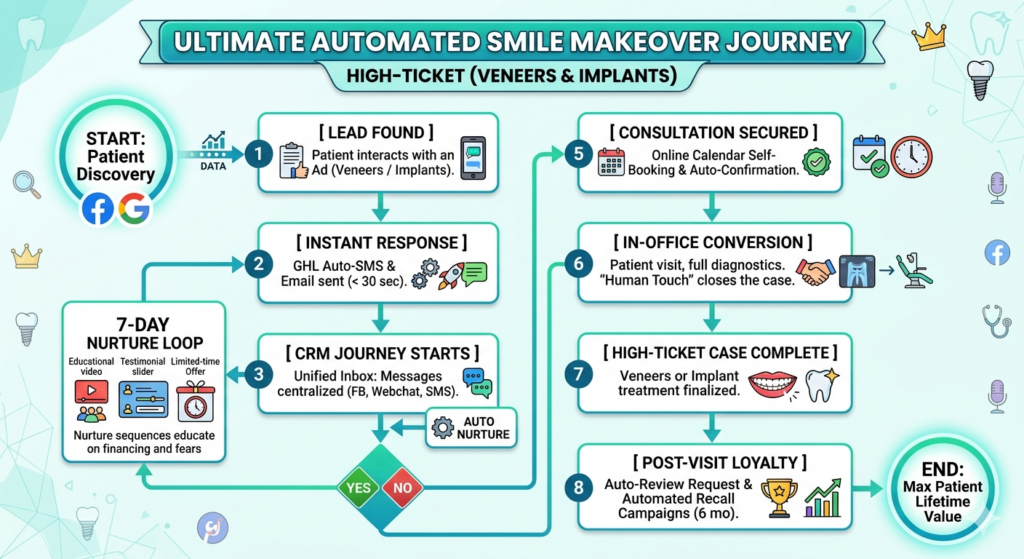
When you aim to Automate High-Ticket Smile Makeovers, you aren’t just sending automated texts; you are building a clinical pathway. High-ticket cases—implants, veneers, and clear aligners—require a different psychological approach than a routine cleaning. They require multiple touchpoints, educational content, and consistent “top-of-mind” awareness.
Automation allows you to deliver this high-touch experience at scale. By centralizing communication into a single dashboard, the clinic owner gains total visibility. You no longer have to ask, “How many leads did we get?” You simply look at the pipeline and see exactly where each patient sits in their journey.Automate High-Ticket Smile Makeovers”For Free Trial
Note: The link below is an affiliate link. I only recommend systems that align with structured clinic growth.
The transition from a manual office to an automated one is the difference between constant firefighting and predictable growth. By removing the burden of manual follow-ups, your team can focus on the patient in front of them.
👉 Start Building a Smarter Dental System
Real Clinic Scenarios: Where the Leakage Happens
To understand the value of a system like GoHighLevel, we must look at the “hidden” losses in a standard day.
Scenario A: The After-Hours Inquiry
A prospective patient chips a tooth at 8:00 PM. They search for a local dentist and fill out your contact form. In a traditional clinic, that lead sits in an email inbox until 9:00 AM the next day. By then, the patient has already called the clinic down the street that had an “Instant Booking” or “AI Chat” feature. The System Solution: An automated “Missed Call Text Back” or an instant SMS acknowledgement with an integrated calendar link.
Scenario B: The “I’ll Think About It” Treatment Plan
You present a $15,000 smile makeover. The patient is interested but needs to talk to their spouse. They leave the office. If your team doesn’t call them back within 48 hours, the emotional momentum is lost. The System Solution: An automated nurture sequence kicks in, sending the patient a “Case Gallery” of similar successful makeovers and a FAQ video regarding financing options. This keeps the value proposition alive without your receptionist having to “nag” them.
Scenario C: The Silent Attrition
A loyal patient misses their six-month cleaning. Life gets busy, and they simply forget. A year passes. They are no longer “your” patient; they are a free agent. The System Solution: Re-activation campaigns that trigger automatically when a patient hasn’t been seen in 7 months, offering a “Welcome Back” incentive.
The Strategic Shift: Automating High-Ticket Smile Makeovers
To truly Automate High-Ticket Smile Makeovers, a clinic must look at the patient journey as a funnel rather than a single event. High-ticket cases are rarely “one-call closes.” They involve an educational phase, a consultation phase, and a financial commitment phase.
By using GoHighLevel’s pipeline management, you can categorize leads based on their intent. If a lead clicks on a video about “Veneers vs. Lumineers,” the system automatically tags them and sends relevant follow-up material. This is “Intelligent Dentistry.” It positions you as the expert before the patient even sits in your chair.
Think of it this way—if your clinic loses even five missed calls per week, that is silent revenue walking away. A structured automation system prevents that leak while building a professional bridge to your most profitable services.
👉 Start Building a Smarter Dental System
Common Mistakes in Clinic Operations
Even with the best intentions, many owners stumble when trying to modernize. Here are the three most common pitfalls:
- Buying the Tool but Not the Process: A CRM like GoHighLevel is a powerhouse, but it requires a pre-defined workflow. You must decide what happens when a lead enters the system.
- Over-Automating: Patients still want to talk to humans. Automation should facilitate the conversation, not replace it. Use AI to handle the “when” and “where,” but keep the “why” and “how” personal.
- Ignoring the Data: If your system shows that 40% of your leads drop off after the price is mentioned, that’s an operational insight. It tells you that your financing presentation needs work. Without the system, you’d just think “the leads are bad.”
The Future of the Structured Clinic
The dental industry is moving toward a bifurcated reality. On one side are the “hustle” clinics—owners who are constantly stressed, chasing new patients to replace the ones they lost due to poor follow-up. On the other side are the “Systematized” clinics.
These owners enjoy:
- Revenue Stabilization: They know exactly how many consultations are booked for next month.
- Reduced Burnout: The front desk is calm because the “busy work” is handled by the CRM.
- Higher Practice Valuation: A business with documented, automated systems is worth significantly more to a buyer or DSO than a person-dependent practice.
Conclusion: Building for Longevity
Growth is not a mystery; it is a mechanical outcome of reliable systems. When you implement a platform like GoHighLevel, you aren’t just buying software; you are installing an infrastructure that supports your clinical expertise. You are ensuring that every dollar spent on marketing and every hour spent in surgery is backed by a system that captures and retains value.
The goal is a practice that serves you, rather than you serving the practice. By deciding to Automate High-Ticket Smile Makeovers and streamline your patient lifecycle, you are choosing professional freedom over operational chaos.
Modernizing your practice doesn’t have to be an overnight overhaul. It starts with a single step toward centralizing your communications and automating your most frequent points of failure.
👉 Start Building a Smarter Dental System
Frequently Asked Questions
Q: Is this system difficult for my front desk to learn? A: Most modern CRMs are designed with “User Experience” in mind. While there is a learning curve, it is significantly lower than the “mental load” of managing hundreds of manual tasks.
Q: Will automation make my practice feel “cold” or “robotic”? A: Quite the opposite. By automating the boring stuff (reminders, confirmations), your team has more time to provide genuine, warm, and focused attention to the patients who are physically in the office.
Q: How long does it take to see a return on investment (ROI)? A: Most clinics see an immediate ROI in “Missed Call Recovery” alone. Recovering just one or two mid-value cases that would have otherwise gone to a competitor often covers the annual cost of the software.
Q: Can I integrate this with my existing Practice Management Software (PMS)? A: Yes. Tools like GoHighLevel can often be synced with major PMS providers via middleware or direct integrations to ensure your schedules and patient data remain consistent across all platforms.
Q: I’m not a “tech person.” Can I still do this? A: You don’t need to be a coder. You need to be a strategist. You define the “Patient Journey,” and the system executes the steps. Many owners choose to have a specialist set up the initial “snapshots” so the system is ready to go from day one.