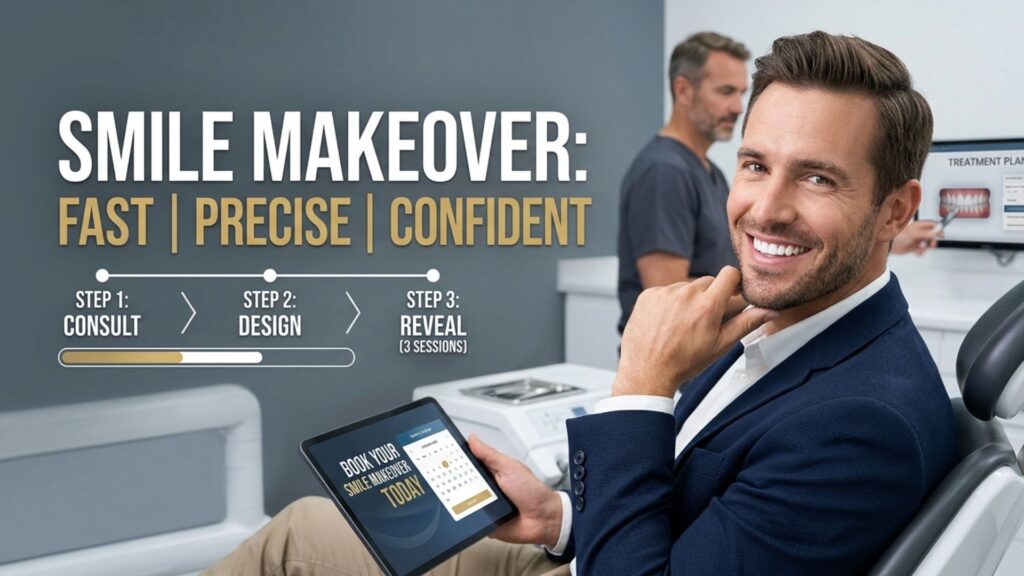
As a dental clinic owner, you’ve likely mastered the clinical side of the chair. You provide exceptional care, your margins on high-value cases are theoretically strong, and your staff is hardworking. Yet, many practitioners find themselves hitting an invisible ceiling. Despite clinical proficiency, the schedule remains volatile, the front desk is perpetually “busy” but leads are slipping through the cracks, and your high-value procedures—the ones that actually drive growth—aren’t filling the books as they should.
The hard truth of modern dental operations is this: Growth does not come from better dentistry alone; it comes from intelligent systems.
If you want to Book More Smile Makeovers Fast, you cannot rely on the manual memory of a receptionist or the hope that a patient will remember to call you back after a consultation. You need a system that treats every patient touchpoint as a data point, ensuring that no lead is left to “cool off” and no chair time is wasted.
1. The Operational Pain Points: The High Cost of “Busy”
Most dental clinics operate in a state of “functional chaos.” The front desk is the heartbeat of the clinic, but it is also the primary bottleneck. On any given Tuesday morning, a receptionist might be:
- Checking in a patient.
- Handling an insurance claim dispute.
- Answering a pricing inquiry.
- Trying to re-book a cancellation.
When the phone rings during this peak time, it often goes to voicemail. Research in healthcare operations suggests that over 30% of first-time callers will not leave a message; they simply call the next dentist on the Google search list. This is “missed-call leakage,” and it is the silent killer of marketing ROI.
Furthermore, the “No-Show” economics are devastating. A gap in the hygiene schedule is a nuisance; a no-show for a multi-thousand-dollar restorative case is an operational failure. Without a structured system to confirm, remind, and nurture these patients, you are essentially gambling with your overhead.
| Feature | Traditional Manual Clinic | GHL Powered Intelligent Clinic |
| Lead Response | Missed calls go to voicemail; response takes hours. | Instant “Auto-Text Back” within 30 seconds. |
| Appointment Booking | Manual phone tag and back-and-forth scheduling. | 24/7 Self-Booking via synced digital calendars. |
| Lead Nurturing | Staff forgets to follow up with “thinking” patients. | Automated SMS/Email sequences with testimonials. |
| No-Show Prevention | One manual reminder call (if staff has time). | Multi-channel Reminders (24h/1h before visit). |
| Review Generation | Asking patients verbally (often forgotten). | Automatic Review Requests sent post-treatment. |
| Data Visibility | “Guesswork” on which ads are actually working. | Live Dashboard tracking every dollar of ROI. |
2. What “Intelligence” Means in a Dental Clinic
In a high-performing practice, “intelligence” isn’t about the IQ of your staff—it’s about the architecture of your workflows. We categorize this into two segments: Human Intelligence and System Intelligence.
Human Intelligence
This is the “soft” side of the practice. It’s your treatment coordinator’s ability to empathize with a patient’s dental anxiety or your ability to explain the long-term benefits of a dental implant. This is irreplaceable. However, human intelligence is expensive and finite. If your highly-trained coordinator is spending three hours a day playing phone tag to confirm appointments, you are mismanaging your most valuable human asset.
System Intelligence
This is the digital infrastructure that handles the “grunt work.” System intelligence doesn’t get tired, it doesn’t forget to follow up, and it doesn’t feel awkward asking for a deposit. It includes:
- Automated Patient Lifecycle Management: Moving a patient from “Inquiry” to “Consultation” to “Treatment Plan Accepted.”
- Centralized Communication: Having SMS, email, and phone records in one dashboard so the team always knows the context of the last conversation.
- Data Visibility: Knowing exactly how many “Smile Makeover” leads came in last month and exactly where they stalled in the pipeline.
3. Bridging the Gap with AI & Automation
The transition from a manual clinic to a systems-driven clinic requires the right infrastructure. This is where platforms like GoHighLevel have become instrumental for small-to-mid-sized practices. Rather than having five different softwares—one for SMS, one for email marketing, one for a CRM, and one for landing pages—intelligent clinics centralize everything.
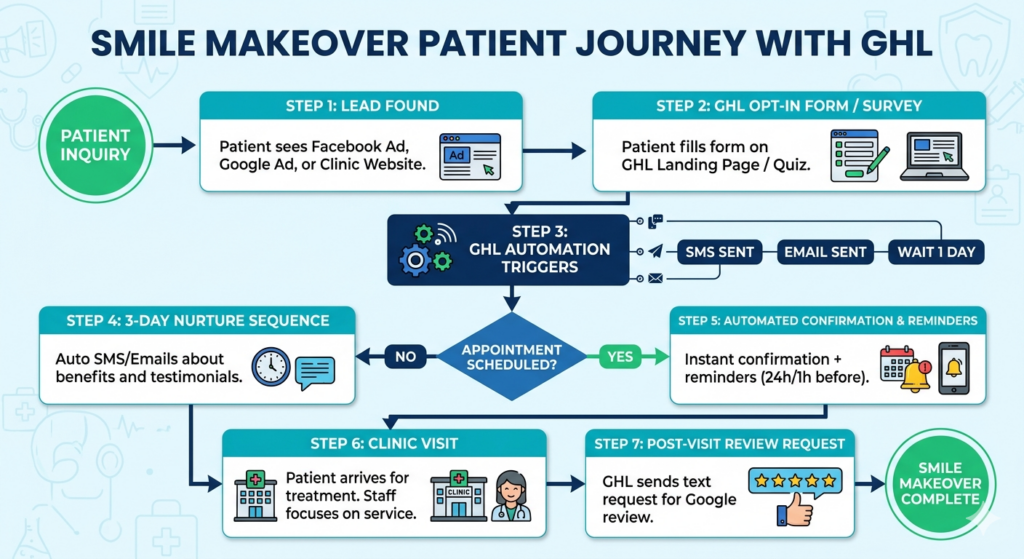
When you implement healthcare automation, you aren’t replacing the human touch; you are protecting it. For example, when a potential patient clicks an ad or visits your site to learn how to Book More Smile Makeovers Fast, an automated system can instantly:
- Send an immediate “Speed to Lead” SMS response.
- Provide a link to a digital gallery of before-and-after cases.
- Offer a direct booking link for a preliminary consult.
This happens in seconds, while your front desk is busy assisting the patient currently in the office. This ensures the lead is “captured” before they move on to a competitor.
Note: The link below is an affiliate link. I only recommend systems that align with structured clinic growth.
Think of it this way—if your clinic loses even five missed calls per week, that’s silent revenue walking away. A structured automation system prevents that by providing a “Safety Net” for every interaction.For Free Trial
4. Real Clinic Scenarios: From Leakage to Leverage
Let’s look at two common scenarios to see how system intelligence changes the outcome.
Scenario A: The Traditional Follow-Up
A patient comes in for a cosmetic consultation. They are interested in veneers but need to “think about the financing.” They leave the office. The receptionist writes a note to call them in three days. Three days later, the office is slammed with an emergency surgery. The call isn’t made until day six. By then, the patient’s initial excitement has faded, or they’ve been distracted by other life expenses. The lead goes cold.
Scenario B: The Automated Follow-Up
The same patient leaves the office. The moment the treatment coordinator marks the status as “Pending Decision” in the CRM, the system triggers a pre-set workflow:
- Day 1: An automated, personalized email arrives with a video testimonial of a similar case.
- Day 3: A text message goes out asking if they had any follow-up questions about the financing options discussed.
- Day 7: If no booking has occurred, the system alerts the coordinator to make a personal “Human Intelligence” call.
In Scenario B, the system did 90% of the nurturing, ensuring the clinic stayed top-of-mind without adding a single task to the staff’s manual to-do list. This is the most effective way to optimize your patient acquisition and ensure your marketing spend isn’t being wasted.
5. Common Mistakes in Dental Operations
In my experience as a strategist, the biggest mistake clinic owners make is throwing more marketing money at a broken bucket.
If your internal systems are not tracking leads, if your “missed call” rate is over 10%, and if your follow-up is inconsistent, doubling your ad spend will only double your frustration. You will get more leads, but you will also lose more leads.
Other common pitfalls include:
- Software Bloat: Using too many disconnected tools that don’t talk to each other.
- Lack of Lead Ownership: Not knowing which staff member is responsible for which stage of the patient journey.
- Inconsistent Reminders: Sending only one text 24 hours before an appointment, which is often too late for a patient to rearrange their life (and too late for you to fill the hole if they cancel).
6. Revenue Stabilization Without Burnout
The “Burnout” in dentistry often comes from the unpredictability of the business. When the schedule is thin, the stress is high. When the schedule is overbooked and chaotic, the stress is also high.
Systematizing your clinic with a platform like GoHighLevel allows for Revenue Stabilization. By automating the “Recall” process and the “Unscheduled Treatment” follow-ups, you create a steady floor of appointments. You stop relying on “heroic efforts” from your staff and start relying on the “boring consistency” of your software.
Implementing these systems doesn’t happen overnight, but the shift in clinic culture is palpable. The front desk feels supported rather than overwhelmed, and the owner can focus on the clinical work they love, knowing the business “engine” is running in the background.
To move away from the “busy-ness” trap, you need a single source of truth for your patient communications and lead tracking. Transitioning to an integrated platform allows you to see the gaps in your funnel and close them with precision.
[👉Start Building a Smarter Dental System](INSERT YOUR AFFILIATE LINK HERE)
7. The Future of the Structured Clinic
We are moving into an era where patients expect the same “Amazon-style” convenience from their healthcare providers. They want to book online at 9:00 PM, they want text confirmations, and they want quick answers to their questions.
Clinics that embrace these “Intelligent Systems” will thrive because they provide a superior patient experience while maintaining lower operational overhead. Those that cling to paper charts and manual callbacks will find it increasingly difficult to compete for high-value cases.
To Book More Smile Makeovers Fast, you must stop thinking of yourself as just a dentist and start thinking as a systems architect. Your clinical skill gets them in the chair once; your systems keep the chair full and the business profitable.
Conclusion
Success in modern dentistry is a trifecta of clinical skill, patient rapport, and operational infrastructure. By automating the repetitive, tracking the missed opportunities, and centralizing your communications, you regain control over your time and your revenue.
Stop letting your hard-earned leads slip through the cracks of a busy front desk. It’s time to build a practice that works as hard as you do.
[👉Start Building a Smarter Dental System](INSERT YOUR AFFILIATE LINK HERE)
Frequently Asked Questions (FAQs)
1. Is automation too “impersonal” for a dental practice? Actually, it’s the opposite. By automating the routine reminders and follow-ups, your staff has more time to engage deeply with the patients who are physically in the office. It removes the “rushed” feeling from the front desk.
2. How long does it take to see results from a system like GoHighLevel? Most clinics see an immediate “catch” in missed calls within the first 48 hours of implementing an automated missed-call-text-back feature. Long-term revenue stabilization typically takes 60–90 days of consistent data tracking.
3. Do I need to be a “tech person” to run these systems? No. The goal of a strategist is to set up the “railroad tracks” so your team can simply drive the train. A well-configured CRM should make your life simpler, not more complex.
4. Can this help with staff retention? Yes. One of the leading causes of dental front-desk burnout is the feeling of being “perpetually behind.” Systems provide clarity, reduce repetitive tasks, and allow staff to succeed in their roles.