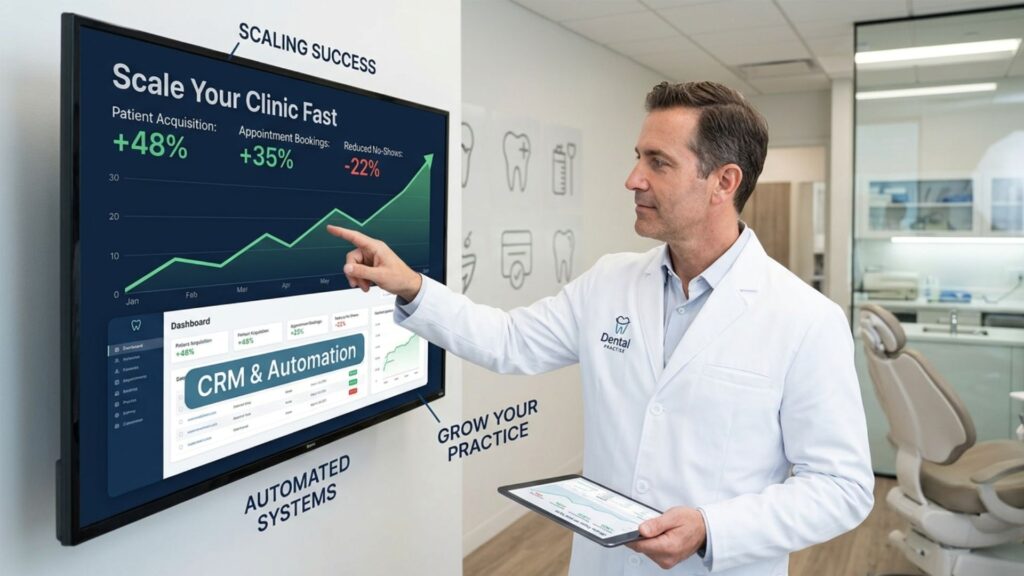
For most dental practice owners, the ceiling isn’t defined by clinical expertise. You have spent years refining your hand-skills, mastering complex restorative cases, and staying current with the latest endodontic techniques. Yet, many high-caliber clinicians find themselves trapped in a plateau.
The frustration is palpable: the schedule has gaps, the phone rings but the appointment book doesn’t fill, and the “no-show” remains a persistent leak in the bucket. When owners think about how to scale your clinic fast, the instinct is often to work more hours or hire another associate.
However, scaling is not a feat of endurance; it is a feat of engineering. True growth in a modern dental environment is the result of shifting from a person-dependent business to a system-dependent one. To move from a chaotic day-to-day existence to a predictable, high-revenue operation, you must implement “System Intelligence.”
1. The Operational Pain Points: The Silent Revenue Killers
“The typical dental office is a hub of ‘leaky’ processes, which makes it nearly impossible to scale your clinic fast. While your front desk team is hardworking, they are often overwhelmed by the sheer volume of fragmented tasks. This manual workload leads to three primary revenue killers that stall growth and prevent you from building a high-performing practice:”
- Missed-Call Leakage: Research indicates that roughly 30% of calls to dental practices go unanswered or are placed on hold long enough for the caller to hang up. In a high-value industry like dentistry, where a single implant lead can represent thousands of dollars, a missed call is a discarded check.
- The “No-Show” Economics: A vacant 60-minute chair doesn’t just cost you the production value of that slot; it costs you the overhead—staffing, utilities, and materials—that continues to run regardless of patient attendance.
- Fragmented Follow-ups: Most clinics have a “pending treatment” list that is essentially a graveyard. Without a structured way to nurture patients who “need to think about it,” those high-value treatment plans rarely convert.
To scale your clinic fast, you cannot simply ask your staff to “work harder.” You must provide them with a framework that automates the mundane so they can focus on the human.
FOR More Information
2. What Intelligence Means in a Dental Clinic
In a clinical setting, intelligence is usually defined by diagnostic accuracy. In a business setting, intelligence is defined by visibility and automation.
An “intelligent” clinic is one where the owner knows exactly how many leads entered the funnel yesterday, how many were booked, and why the others weren’t. It is a clinic where a patient who cancels an appointment is automatically prompted to reschedule within minutes, without a receptionist needing to remember to call them.
3. Human Intelligence vs. System Intelligence
Your staff’s “Human Intelligence” should be reserved for high-level tasks: patient empathy, explaining complex treatment plans, and chairside care.
“System Intelligence,” on the other hand, handles the repetitive logic. If $X$ happens, then do $Y$.
- Human Intelligence: Noticing a patient looks nervous and offering a blanket.
- System Intelligence: Detecting a missed call and instantly sending a text: “Sorry we missed you! We’re with a patient, but would you like to book a consultation link here?”
By automating the logic, you eliminate the “human error” factor that prevents growth.
4. AI & Automation: Integrating Clinical Infrastructure
This is where modern CRM (Customer Relationship Management) tools, such as GoHighLevel, transition from being “marketing tools” to “operational infrastructure.”
“For a dental practice, a system like GoHighLevel acts as the central nervous system that allows you to scale your clinic fast. It connects your website, your social media, your Google Business Profile, and your phones into one unified dashboard. Instead of checking five different places, your office manager sees a single ‘Pipeline’ of opportunities, ensuring that no lead is lost and your growth remains on a predictable, upward trajectory.”
Automation allows for:
- Automated Recall: Re-engaging hygiene patients who haven’t been in for 6+ months.
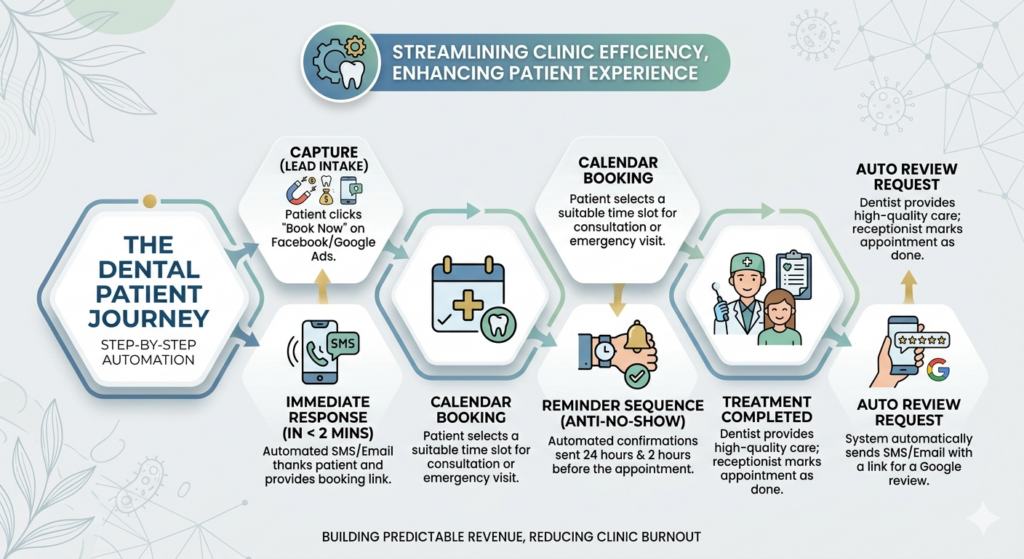
- Instant Lead Response: Responding to a web inquiry in under 2 minutes (which increases conversion rates by nearly 400%).
- Unified Messaging: SMS, Email, and Voicemail drops all working in a sequence to ensure no patient falls through the cracks.
Managing a clinic without these tools is like practicing dentistry without a high-speed handpiece—you might get the job done, but it’s inefficient and exhausting.
Note: The link below is an affiliate link. I only recommend systems that align with structured clinic growth.
“Think of it this way—if your clinic loses even five missed calls per week, that’s silent revenue walking away. A structured automation system prevents that leak, ensures every opportunity is tracked, and provides the digital foundation you need to scale your clinic fast.”
5. Real Clinic Scenarios: Systems in Action
Let’s look at how these systems solve real-world bottlenecks.
Scenario A: The After-Hours Inquiry
A prospective patient experiences tooth pain at 9:00 PM. They find your website and submit a contact form. In a traditional clinic, that form sits in an email inbox until 8:30 AM the next day. By then, the patient has called the clinic down the street that answered their phone.
The System Solution: The CRM triggers an immediate text response with an online booking link. The patient books their emergency slot for the next morning. The “sale” is closed while you are asleep.
Scenario B: The Treatment Plan “Thinker”
A patient is presented with a $5,000 restorative plan. They say, “I need to talk to my spouse.” In many clinics, this lead is lost forever.
“The System Solution: The front desk moves the patient to a ‘Pending Treatment’ stage in the CRM. This triggers a three-part educational email sequence over the next week, explaining the benefits of the procedure and the risks of delay. On day four, they receive an SMS offering a quick Q&A call with the coordinator. By automating this persistent follow-up, you close more high-value cases and finally scale your clinic fast without adding manual work for your team.”
6. Common Mistakes When Trying to Scale
Many owners attempt to scale your clinic fast by pouring money into aggressive Facebook or Google ads. This is a mistake if your internal systems are broken.
- Marketing into a Leaky Bucket: Spending $3,000 on ads when your front desk only answers 60% of calls is a waste of capital. Fix the capture system first.
- Over-complicating the Tech Stack: Using five different softwares that don’t talk to each other creates “data silos.” You need an all-in-one environment where the CRM handles the communication.
- Neglecting the “Database Goldmine”: Your existing patient list is your most profitable asset. Automating “Sleeper” campaigns to reactivate old patients is significantly cheaper than acquiring new ones.
Effective scaling requires you to look at your practice as a series of conversion points. According to the American Dental Association (ADA), operational efficiency is a primary driver of long-term practice sustainability.
7. The Future of the Structured Clinic
The dental industry is moving toward consolidation. Private equity-backed groups (DSOs) succeed not because they provide better clinical care, but because they have superior systems. To compete as an independent or small group, you must adopt the same level of operational rigor.
Automation is no longer a “luxury” for large practices; it is the entry requirement for any owner who wants to reduce burnout. When the system handles the follow-ups and the reminders, the owner can return to being a doctor, and the staff can return to being caregivers.
Systematizing your patient journey ensures that growth is a choice, not a chaotic accident. It allows you to stabilize your revenue and eventually exit or scale without the business collapsing in your absence.
[Start Building a Smarter Dental System](INSERT YOUR AFFILIATE LINK HERE)
| Feature | Starter Plan | Unlimited Plan | Pro / SaaS Plan |
| Monthly Cost | $97 | $297 | $497 |
| Best For | Single-location solo practices. | Growing clinics with multiple sub-accounts. | Large elite clinics & Dental Agencies. |
| Sub-Accounts | 1 Account Only | Unlimited | Unlimited |
| Core CRM & Funnels | Included | Included | Included |
| Email/SMS Automation | Basic | Advanced | Advanced + AI Integration |
| Unified Inbox | Included | Included | Included |
| White Labeling | No | Basic | Full (Your Own Branding) |
| AI Employee/Bot | Manual Setup | Included | Advanced AI Conversational |
| SaaS Mode | Not Available | Not Available | Enabled (Resell the software) |
8. Conclusion
To scale your clinic fast, you must stop looking for a “magic marketing pill” and start building a sturdier machine. Clinical excellence gets patients in the door once; system excellence keeps them coming back and ensures no new lead is ever ignored.
By implementing a centralized CRM like GoHighLevel, you are not just buying software; you are installing an infrastructure that tracks every dollar, recovers every missed call, and automates the follow-up work that your team is too busy to perform.
Invest in the systems that support your skill. That is the only path to sustainable growth.
FAQs (Frequently Asked Questions)
How does automation help with no-shows?
Automation uses “multi-channel” reminders. Instead of just one phone call, the system sends a sequence of SMS, email, and even automated “ringless voicemails.” This ensures the patient sees the reminder on the device they use most, significantly reducing the likelihood of a forgotten appointment.
Is GoHighLevel difficult for a non-tech-savvy dental team to use?
While any new tool has a learning curve, the benefit of a centralized CRM is that it replaces 3-4 other tools. Once the “snapshots” (pre-built dental workflows) are installed, the team typically finds it easier because they only have one dashboard to check instead of multiple disjointed apps.
Will automation make my practice feel “impersonal”?
Actually, it’s the opposite. By automating the “logistics” (reminders, booking, directions), your staff has more time to have meaningful, unhurried conversations with patients when they are actually in the office. Automation handles the “noise” so humans can handle the “connection.”
How quickly can I expect to see results from system intelligence?
Most clinics see a “quick win” within the first 30 days simply by activating “Missed Call Text-Back.” Recovering just two or three high-value cases that would have otherwise gone to a competitor often pays for the entire year’s system costs.